Fakes & Forgeries: How to Spot Fakes in the Antiques Market - AUCBURG | AUCBURG
Fakes & Forgeries: How to Spot Fakes in the Antiques Market
The antiques market is flooded with composite fakes and outright junk. Therefore, the main task of an antiques dealer is not just to admire the elegance of an item, but to be able to recognize a forgery in its details, find inconsistencies in materials and technologies, and identify hidden traces of restoration.
The antiques market is flooded with composite fakes and outright junk. Therefore, the main task of an antiques dealer is not just to admire the elegance of an item, but to be able to recognize a forgery in its details, find inconsistencies in materials and technologies, and identify hidden traces of restoration.
A recent story illustrates this problem. A seller appeared with an offer to sell a set of Adolf Hitler's personal belongings. The items were allegedly stored in a bank safe deposit box, and the seller could only provide photographs and a certificate of authenticity. The value of the set was estimated at 10 million rubles.
The collection's origin was explained by the fact that its owner was a 'very important person' who had acquired the items from Marshal Zhukov's granddaughter. It was claimed that the marshal had personally selected the items for his collection from Hitler's office, so forgeries were out of the question.
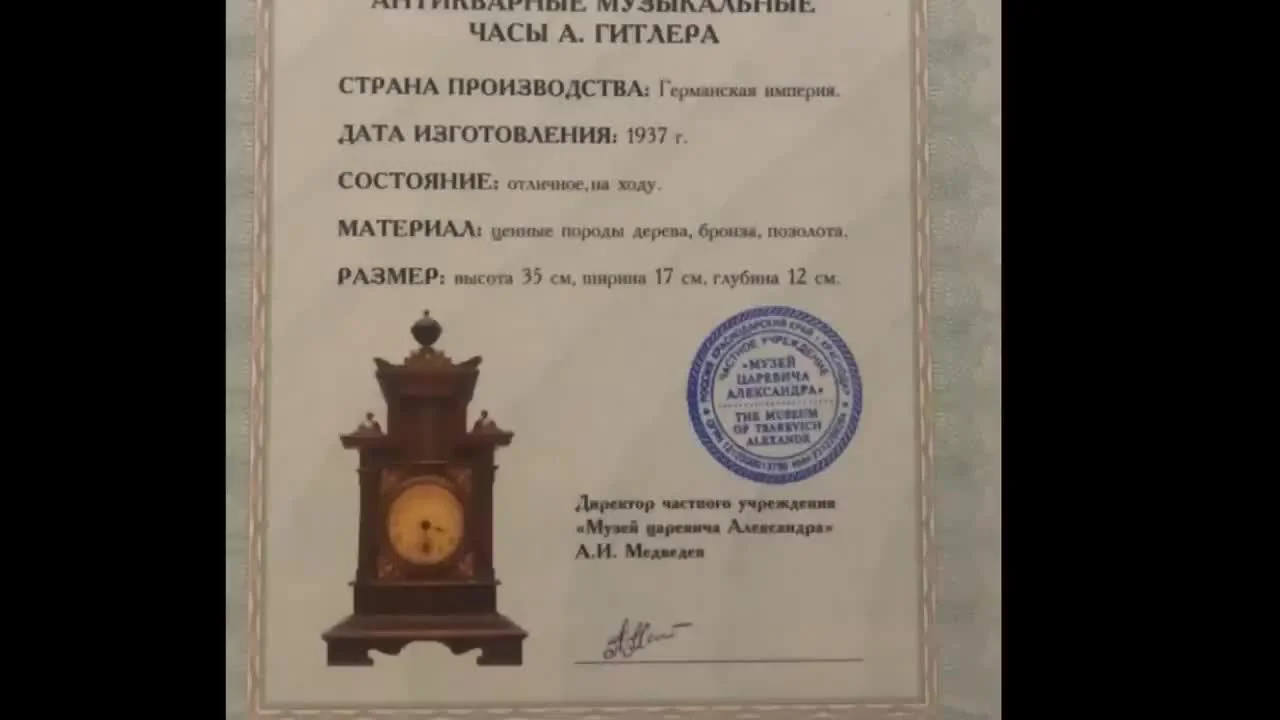
Examination of 'Hitler's Clock'
However, a closer examination of the photographs revealed numerous inconsistencies indicating a crude forgery. A detailed analysis of the clock revealed many signs of artisanal, garage-level production.
The case was crudely made, presumably in a garage workshop.
The back panel of the mechanism was crookedly sawn.
The winding springs for the mechanism were a composite, taken from other clocks.
Since the springs had no housing, a rough steel bracket was installed in its place.
An image was engraved on the mechanism's frame with a rotary tool, which was supposed to be the imperial eagle but looked more like a 'sick pterodactyl'.
Additionally, the clock had a worn piece of paper with French writing on it, which seems extremely strange for a personal item of Hitler's, given his penchant for national identity. The musical mechanism, which supposedly played a Wagner melody, looked very much like the innards of a simple children's toy in the photo.
Hitler's and Mussolini's Daggers
The set also included daggers attributed to Adolf Hitler and a bayonet allegedly given to him by Benito Mussolini. The daggers turned out to be two ordinary Austro-Hungarian hunting daggers in poor condition. The fraudsters tried to emphasize their 'connection' to Hitler by engraving initials on the blade and guard. However, they failed to account for the fact that Hitler had his own monogram with interlocking letters.
A German police dress bayonet, identified as a gift from Mussolini, was also adorned with fake initials. The story of how a gifted item ended up back in the Führer's office is simply baffling.
Thus, after being engraved with the initials of famous individuals, completely ordinary items acquire a new provenance, and their value increases significantly for uninformed buyers. Such forgeries are often sold to high-ranking individuals who are confident in their own importance and wish to conceal their income, as they are unlikely to go to the police.
Hitler's and Mussolini's Daggers
Silver Forgeries on Online Auctions
Type of Enamel
Description
Hot Enamel
Has a structure similar to glass. It is hard, and it's impossible to leave a mark on it with a needle.
Cold Enamel
Is a two-part epoxy resin with a colorant. After hardening, it remains flexible and can be pierced with a needle.
Forgeries are also common on online platforms. For example, a set of spoons with 19th-century Russian Empire hallmarks, richly decorated with enamel, was presented. The items were purchased on eBay from a seller with positive feedback. However, their manufacturing quality was quite mediocre for the 19th century.
Unfinished seams from the casting mold and traces of unevenly distributed metal are clearly visible on the spoons. This is a significant sign of forgery, as in genuine workshops, spoons are not cast but stamped using a powerful press, so there should be no casting marks on them.
The enamel also turned out to be fake. To distinguish real hot enamel from a fake, it's important to know their properties.
The enamel on the spoons was applied unevenly, with bleeding edges, which is characteristic of 'cold enamel.' This is another clear sign of falsification.
Composite Items and Fake Hallmarks
On online auctions, one can also find so-called 'composite' items. An example is an 'antique Russian silver spoon for sifting sugar by hand.' This item is assembled from two completely different parts: the handle from a broken spoon and a sifter to which a shank was crudely soldered.
Besides the structural inconsistencies, the item's authenticity is questionable due to incomprehensible inscriptions and the absence of a hallmark. It can only be called silver conditionally because it shines.
Another example is a tea spoon, which was described in the listing as a 'sugar spoon.' In the late 19th and early 20th centuries, sugar was lumpy, and granulated sugar only appeared in the second half of the 20th century, so such spoons were used for tea. On the bowl of this spoon, the patterns are made with epoxy resin, and the hallmark and maker's mark were applied by etching, as evidenced by the crooked letters and numbers distorted by acid. This calls into question the declared precious metal content of the item.
Figurine with a Fake Fabergé Hallmark
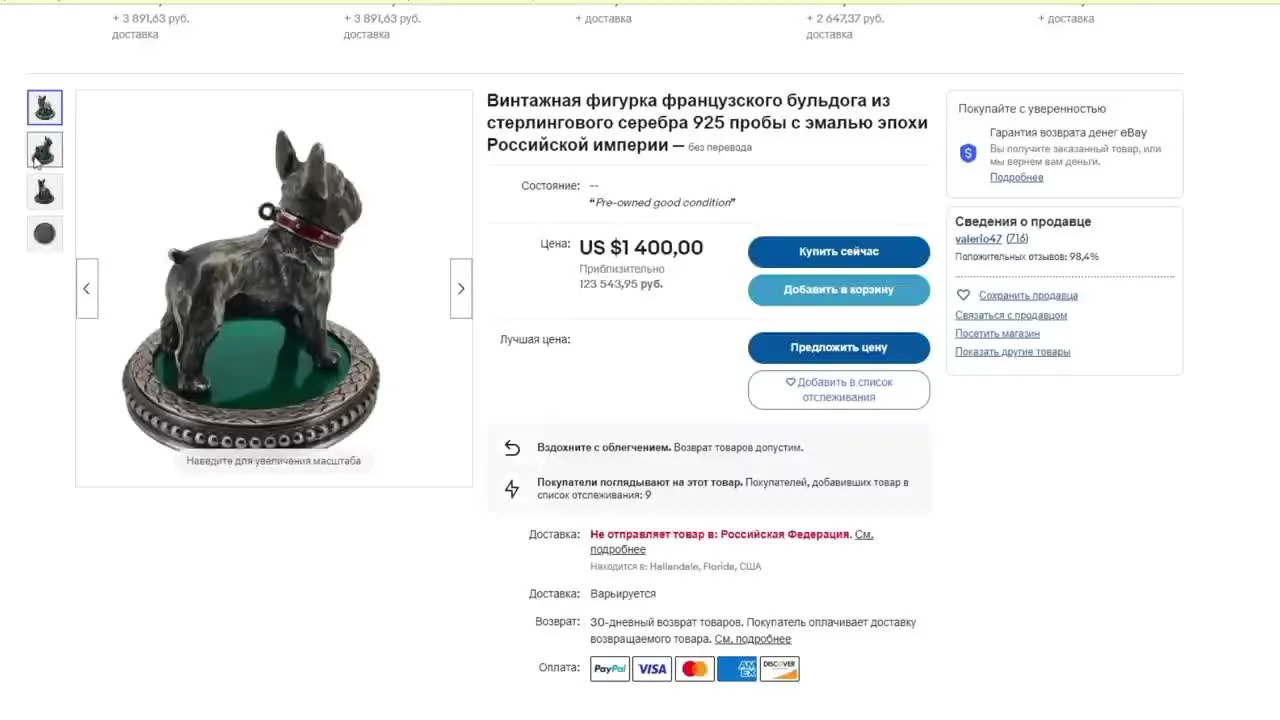
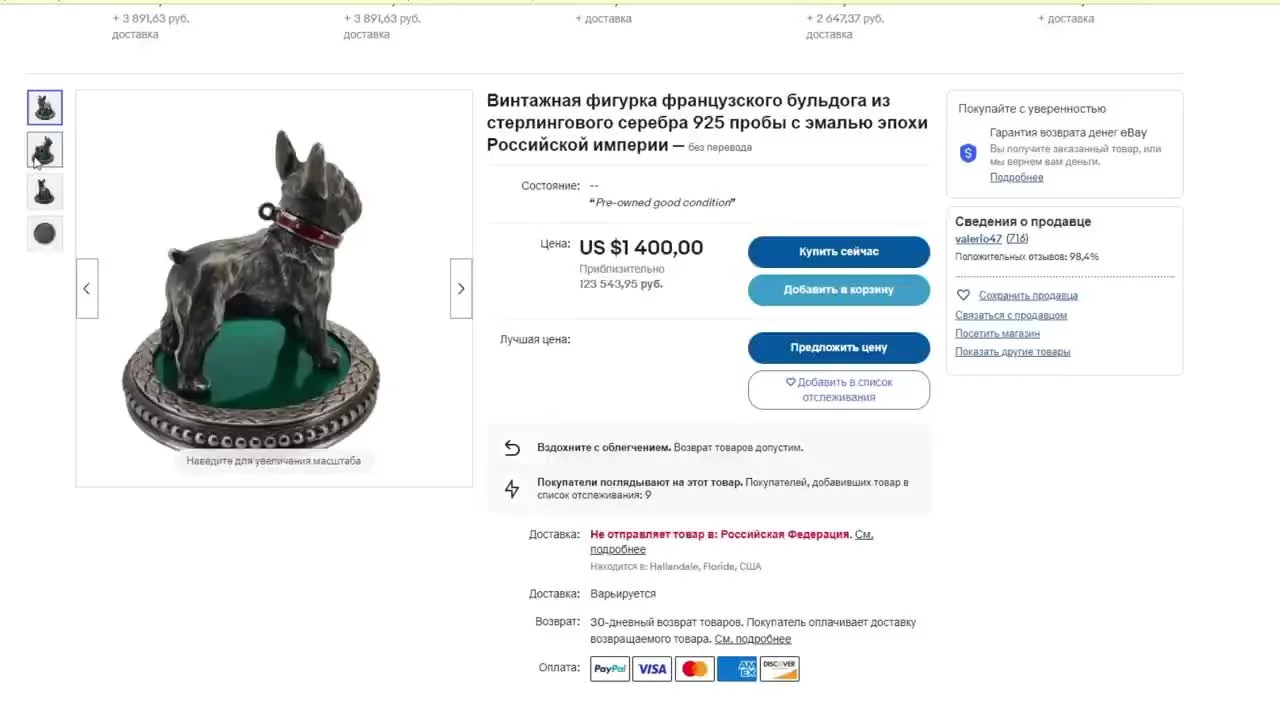
Another glaring example of an outright fake is a 'vintage French bulldog figurine made of 925 sterling silver with enamel from the Russian Empire era.' However, the 925 fineness mark only appeared in the USSR after 1970, and 'sterling' refers to silver with a fineness above 900. Meanwhile, the item itself is marked with an 88 fineness mark.
In terms of metalwork quality, the sculpture more closely resembles a keychain from AliExpress, mounted on a pedestal and coated with colored epoxy resin. The 'Fabergé' maker's mark, with its crooked letters, was also applied by etching and does not stand up to any scrutiny.
In the antique Russian silver sections on eBay, at least every third item is a forgery. The flow of such fakes is currently curbed by sanctions, but in the future, it could flood the domestic market. Since antique goods are not eligible for exchange or return, one should be cautious and buy items only from places that offer financial guarantees of authenticity.