How to Determine the Value of an Antique Book - AUCBURG | AUCBURG
How to Determine the Value of an Antique Book
Book collecting is a field of collecting centered around books. The main question faced by both novice and experienced collectors is determining the real value of a particular edition. The market forms its own valuations, but how can one understand what a specific book is actually worth?
Book collecting is a field of collecting centered around books. The main question faced by both novice and experienced collectors is determining the real value of a particular edition. The market forms its own valuations, but how can one understand what a specific book is actually worth?
The basis of pricing is the economic concept of the equilibrium price. It is determined at the point where the supply and demand curves intersect, known in economics as the 'Marshallian cross.' The ideal price for a product is reached when the number of people willing to buy it matches the quantity of the product offered at that price.
However, in the antiquarian market, determining supply and demand is significantly more complex than in the market for ordinary goods. Here, value is shaped by a multitude of specific factors that go beyond simple economic analysis.
Common Misconceptions About the Value of Old Books
Many owners of old editions mistakenly believe that any old volume is highly valuable. Questions often arise about the value of inherited books, which owners believe must be worth a fortune.
Typical examples of such misconceptions include:
The Soviet Encyclopedia from the 1950s. Despite its age, it was a mass-produced publication and its value is not high.
An illustrated Bible inherited from a grandmother. Most old Bibles, especially those printed in Old Church Slavonic, are among the most common books and rarely have significant collectible value.
A lifetime edition of Pushkin. While this sounds impressive, such books are not always worth millions, and their price can be quite affordable.
It is important to distinguish truly rare collectible masterpieces from simple old items that were produced in large print runs and were widely distributed.
Common misconceptions about the value of old books
Participants in the Antiquarian Market and the Specifics of Sales
The antiquarian market consists of two main groups: those wishing to sell and those wishing to buy. Buyers, in turn, are divided into collectors seeking specific rare copies and ordinary people purchasing old items as gifts or for interior decoration.
Sellers often hope to solve their financial problems by selling an old book but do not always accurately assess its real value. For example, an ad for a 16th-century handwritten Bible on a popular online platform is most likely a delusion, as genuine rarities of this level are not sold on publicly accessible sites.
Antique fairs and salons
Art dealers who work with wealthy clients
Participants in the antiquarian market and the specifics of sales
How to Date Old Church Slavonic Books
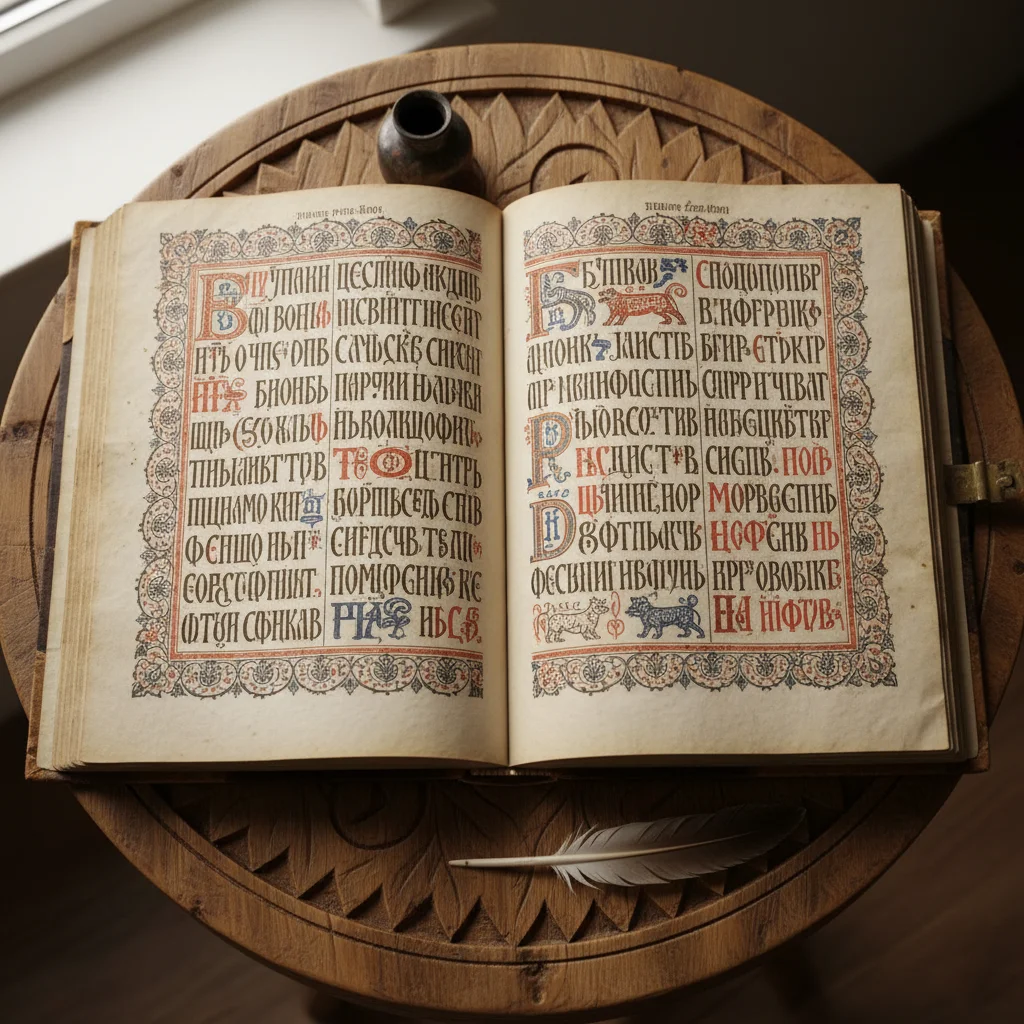
Not every book printed in Old Church Slavonic is handwritten or very old. Orthodox Bibles, for example, were printed not only in Russia but also in Serbia and Bulgaria. To determine the age of such an edition, you should pay attention to the information at the end of the book.
In the so-called 'blessing,' it is usually indicated with whose permission the book was printed. There you can find the name of the metropolitan and, more importantly for dating, the name of the ruling sovereign. For example, the mention of sovereign Nikolai Alexandrovich indicates Nicholas II, and Alexander Alexandrovich indicates Alexander III.
Another dating method is the numerals on the title page. In Old Church Slavonic script, letters of the alphabet were used to denote numbers: 'Az' for 1, 'Buki' for 2, 'Vedi' for 3, and so on. This allows for a fairly accurate determination of the year of publication.
How to date Old Church Slavonic books
Engravings and Printing Techniques
Term
Description
Woodcut
An engraving on wood. The image is carved onto a wooden block, inked, and then an impression is made. The number of copies is limited due to the wear of the wood.
Lithography
An engraving on stone. The drawing is applied to a stone, from which impressions are then printed. It allows for a larger number of copies than a woodcut.
Metal Engraving
The image is carved or etched with acid onto a metal plate. This technique allows for the creation of a large number of impressions.
Illustrations in old books, or engravings, are not handwritten works. They are impressions made using special printing plates. Understanding the technique of their creation helps in valuing the book.
There are various techniques for printing images:
The presence of engravings can affect the value of a book, but it is important to understand that this is a mass-produced item, not a unique handmade work of art.
Engravings and printing techniques
Factors Affecting a Book's Value
The price of an antique book depends on a multitude of factors that can either increase or decrease its value. The key is not just age, but a combination of unique characteristics.
First edition, especially of famous works (e.g., the first book by Jules Verne).
An autograph or dedication from a famous author (e.g., Nobel laureate Boris Pasternak).
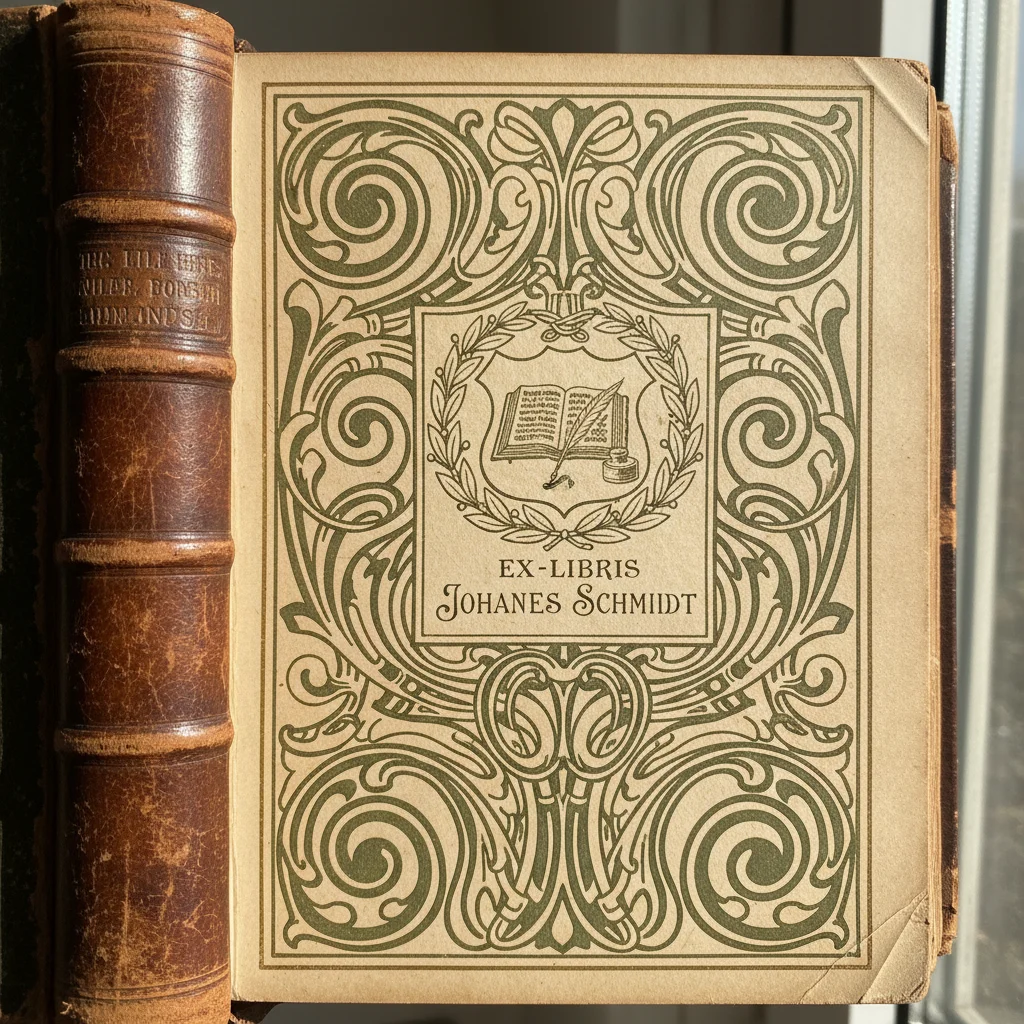
A bookplate (ex-libris) from the library of a famous person or family (e.g., Count Orlov).
A high-quality, well-preserved original binding.
Poor condition: a tattered cover, damaged endpapers, page damage.
Large print run (e.g., most Soviet editions).
A softcover or a later, simplified binding.
An autograph from an unknown author of no historical interest.
Real Prices: From the Soviet Encyclopedia to Shakespeare
The cost of old books varies greatly. For example, a complete set of the Soviet encyclopedia in good condition can be sold for 5,000–6,000 rubles, while the price of a single volume is usually between 100 and 500 rubles.
A lifetime edition of Pushkin, contrary to expectations, can be found on the market for 15,000 rubles. This is because his books were published in a fairly large print run for their time. Of course, there are more expensive copies worth 100,000-200,000 rubles, with prices depending on condition and other factors.
For comparison, lifetime editions of Shakespeare, written 400–500 years ago, are worth millions. Their high price is due to their extreme rarity—very few copies from the small print runs of that time have survived to this day. Thus, it is scarcity and rarity, not just age, that play the key role in establishing a high price.
Real prices: from the Soviet Encyclopedia to Shakespeare