The US $2 Bill: History, Value, and Myths - AUCBURG | AUCBURG
The US $2 Bill: History, Value, and Myths
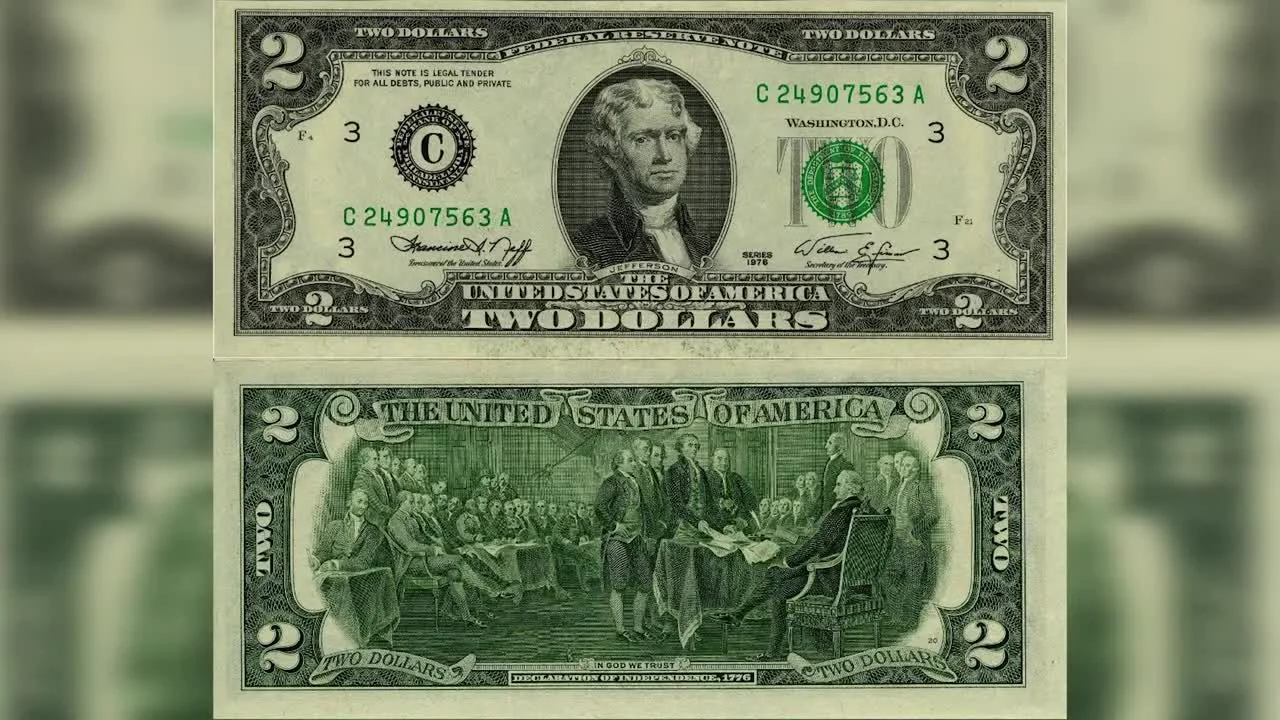
There are many myths surrounding the 2-dollar bill. Many foreigners and even Americans are convinced that it is not in common use and has long been out of circulation. However, this is a misconception, as the bill is still being issued and is legal tender.
There are many myths surrounding the 2-dollar bill. Many foreigners and even Americans are convinced that it is not in common use and has long been out of circulation. However, this is a misconception, as the bill is still being issued and is legal tender.
This banknote has traditionally been issued throughout most of the history of American money production. Two-dollar bills are still printed in the U.S. today, but throughout history, their issuance has been irregular, with varying print runs and frequencies.
History of the Banknote
The first 2-dollar bills were issued in 1862. They were printed by two financial companies from New York. These historic banknotes had their own distinctive features.
The obverse featured a portrait of Alexander Hamilton.
The banknote had a red seal of the U.S. Treasury.
A design similar to the modern one was developed in 1928. In subsequent issues, only minor changes were made that did not alter the overall concept.
History of the Banknote
Collector's Value
Two-dollar bills are of particular interest to collectors, but not all of them are valued by numismatists. The most valuable are the rarest bills, which were issued in small print runs or are antique. Among certain issues, there are truly precious specimens whose value can reach tens of thousands of dollars.
However, it's possible to get a sum exceeding face value for almost any such banknote. This is because collecting this denomination is a national tradition for Americans and a popular hobby for foreigners. Under favorable circumstances, you can get up to $20 for a 2-dollar bill.
Collector's Value
Myths and Superstitions
Belief
Description
Negative
In the past, 2-dollar bills were often used to pay for bets at horse races, in brothels, and for bribing voters. This trail of associations has stuck, and some Americans prefer to get rid of such banknotes.
Positive
It is believed that the two-dollar bill brings luck and wealth. To activate its 'magical' properties, the banknote should be placed in a wallet and carried at all times. According to the belief, this ensures that the wallet will never be empty.
One of the main myths about the two-dollar bill is that it has long been out of circulation. Some Americans believe that its issuance ceased as far back as 1966. Because of this, misunderstandings can sometimes arise when paying with such a banknote, as many people have simply never seen it in person and may consider it non-circulating.
Various superstitions are also associated with the bill. There are both negative and positive beliefs that influence attitudes towards this money.
Therefore, if you come across such a banknote, you should first check its year of issue and potential collector's value. Even if it doesn't turn out to be rare, it can be kept in your wallet as a good luck charm.