The Morgan Dollar: History and Characteristics of the Famous US Coin - AUCBURG | AUCBURG
The Morgan Dollar: History and Characteristics of the Famous US Coin
Among the many silver coins in the world, the 1 dollar coin of the United States of America, known as the 'Morgan dollar,' holds a special place. This coin is hugely popular among collectors due to its expressive design and historical value.
Among the many silver coins in the world, the 1 dollar coin of the United States of America, known as the 'Morgan dollar,' holds a special place. This coin is hugely popular among collectors due to its expressive design and historical value.
The coin owes its name to its designer, George T. Morgan, who created its appearance. It was his surname that became established in numismatic circles as the unofficial name for this famous silver dollar.
Minting History: From the 19th Century to 1921
The minting of the Morgan dollar began in the 19th century and had several stages. The main period of issue occurred at the end of the century, but production was later suspended.
1878: Minting began.
1904: Production was discontinued due to an oversupply of silver money in circulation.
1921: Minting was resumed for one year, and coins from this year are quite common.
Thus, the history of this coin is divided into two main periods, separated by a long pause. The coin featured in this review belongs to the second, final stage of minting.
Minting History: From the 19th Century to 1921
Technical Specifications and Parameters
Parameter
Value
Metal
.900 Silver
Pure silver weight
24 g
Total weight
26.73 g
Thickness
~3 mm
Edge
Reeded
The Morgan dollar is a rather hefty and thick coin, pleasant to the touch. Its thickness is almost 3 millimeters, which makes it stand out among other coins. The main parameters of the coin are presented in the table.
These characteristics are the standard for the Morgan dollar and serve as one of the key criteria for determining its authenticity. The coin's edge has no inscriptions and is simply reeded.
Technical Specifications and Parameters
A Detailed Look at the Design
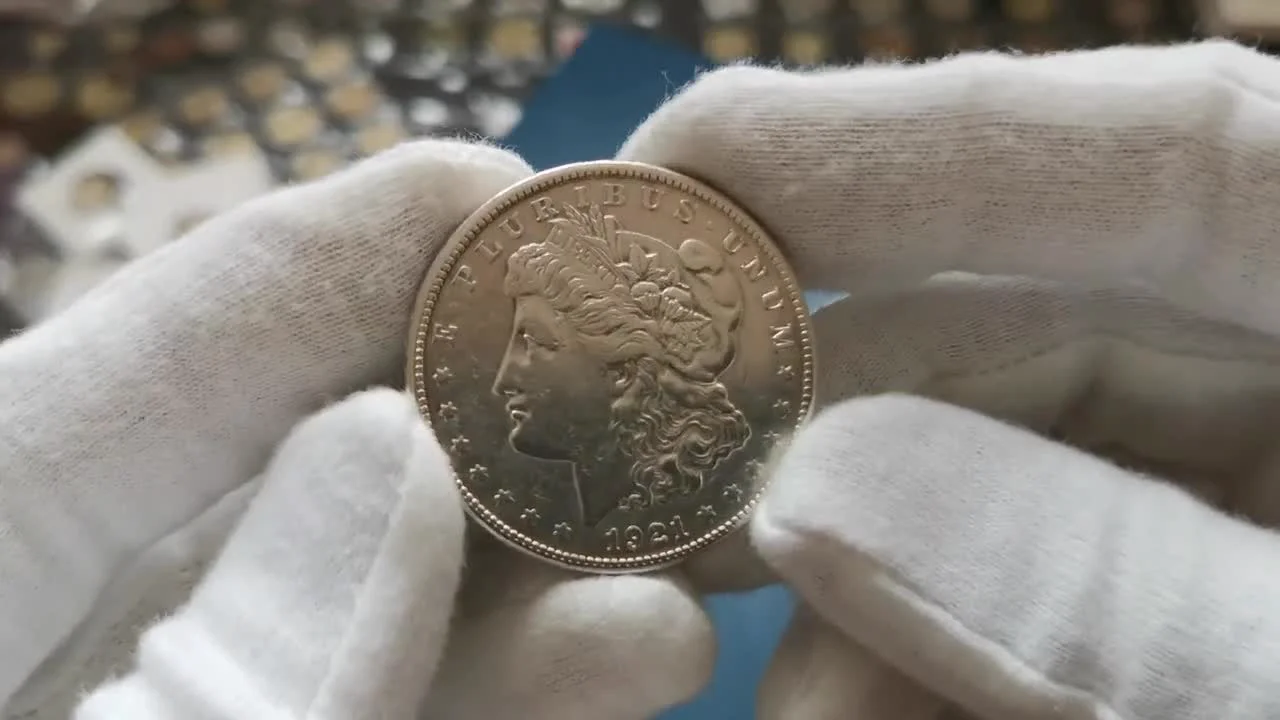
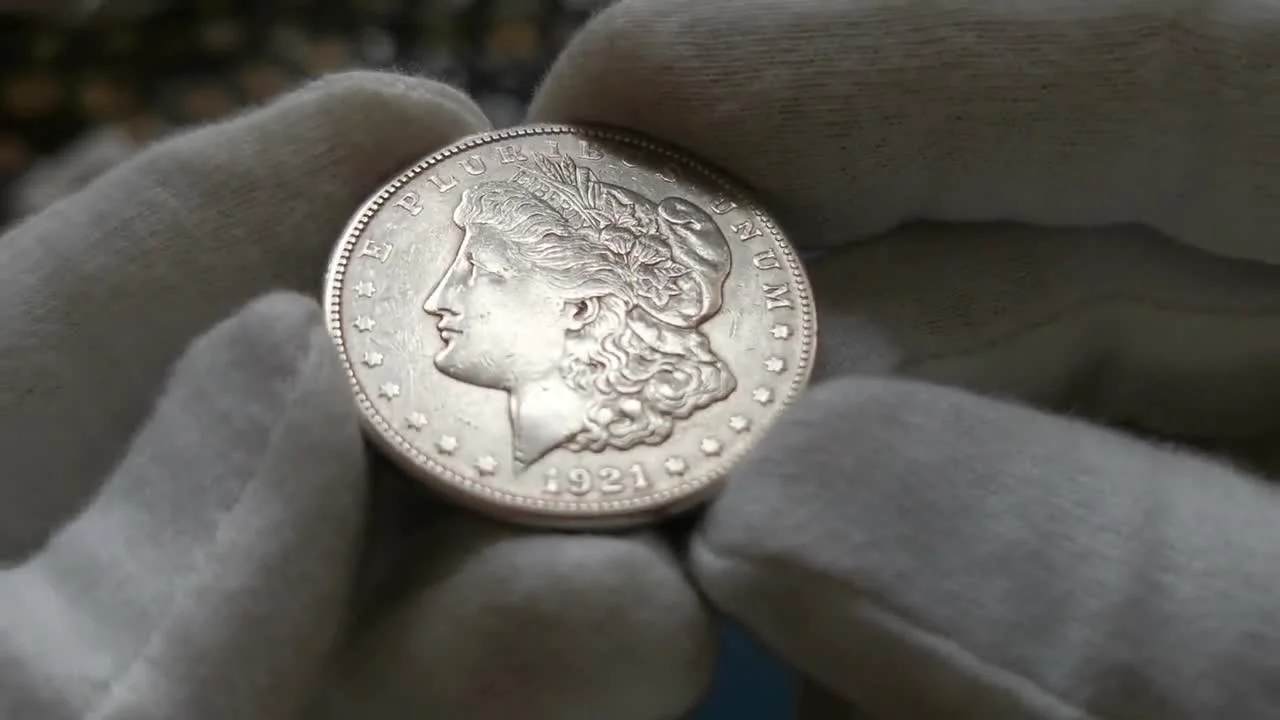
The design of the Morgan dollar is distinguished by its high detail and symbolism. The obverse depicts the head of a woman in a wreath and a Phrygian cap, symbolizing liberty. Notably, the model for this image was a real woman, not an allegorical figure.
The inscription 'LIBERTY' on the wreath.
The Latin motto 'E PLURIBUS UNUM' ('Out of many, one'), attributed to Cicero.
The designer's monogram 'M' (for Morgan) at the base of the neck.
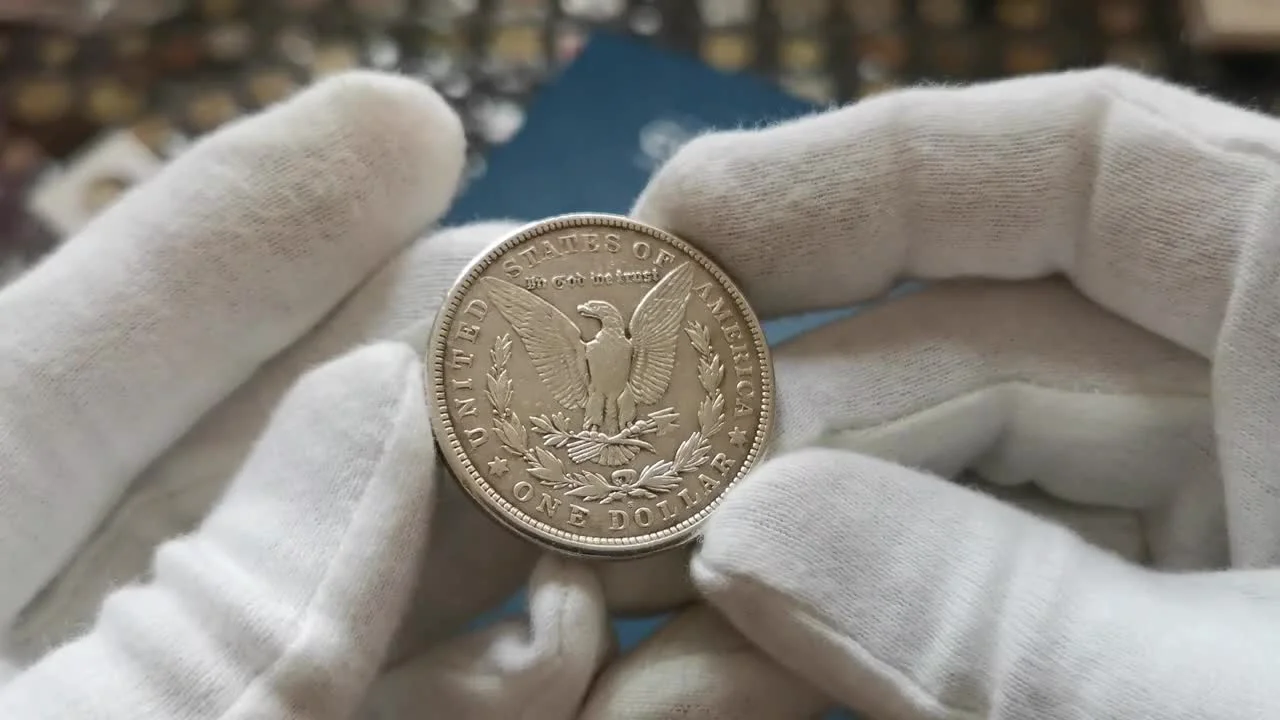
The reverse of the coin features a bald eagle, the national symbol of the USA. In its talons, it holds arrows and an olive branch. The reverse also includes the inscriptions 'UNITED STATES OF AMERICA,' 'ONE DOLLAR,' and the motto 'IN GOD WE TRUST.' The coin has a 'coin alignment,' meaning that when flipped vertically, the reverse appears upside down.
A Detailed Look at the Design
Mintage and Mints
The Morgan dollar was minted at several U.S. mints. They can be distinguished by a special letter mark on the reverse, located above the word 'DOLLAR'.
Philadelphia: coins with no mint mark.
San Francisco: 'S' mint mark.
Denver: 'D' mint mark.
The coin's mintage figures were enormous, especially in 1921, when about 85 million pieces were produced across all mints. For example, the mintage at the San Francisco mint was 21 million, and Philadelphia's was 45 thousand pieces. Due to such large production volumes, the coin is not considered rare, and its value is relatively low—around 1500-2000 rubles.
Mintage and Mints
Common Counterfeits and Authenticity Verification
The high popularity of the Morgan dollar has led to the emergence of a large number of counterfeits of varying quality. It is important to exercise caution when purchasing such a coin. One of the first verification steps is weighing it.
The standard weight of the coin is 26.73 grams. When a 1921 specimen was weighed, the scales showed 26.75 grams. This result is suspicious, as the coin shows signs of circulation and should have lost weight, not weigh more than the standard.
Such a weight discrepancy may indicate that the coin is a counterfeit. There are many ways to verify authenticity, including measuring its thickness, checking for magnetic properties, and other tests that should be performed if there are any doubts.