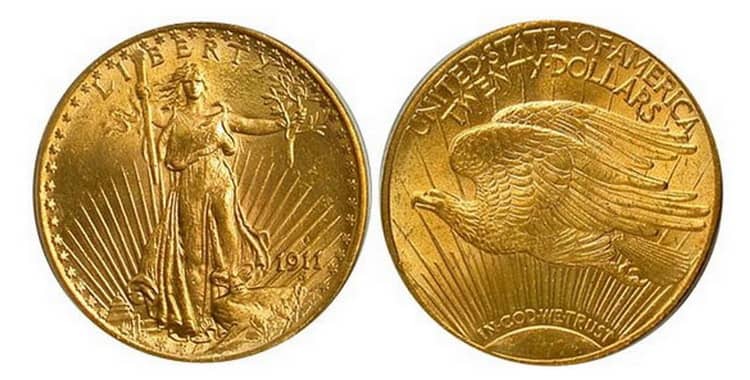
Introducing the 'Double Eagle' Coin
The focus is on a 1926 American $20 gold coin. This specimen is known as the 'Double Eagle.' It is considered the largest U.S. gold coin of its time, weighing nearly 34 grams and containing a troy ounce of pure gold.
This coin not only has significant value due to its metal but is also famous for its artistic execution. Many numismatists and historians recognize it as one of the most beautiful coins ever minted in the United States. It is part of a series whose history is closely linked to the legendary and extremely rare 1933 'Double Eagle,' one of the most expensive coins in the world.
The Coin's Creator and His Presidential Patron
The coin is also called the 'Saint-Gaudens $20' in honor of its designer, the distinguished American sculptor Augustus Saint-Gaudens. The idea of creating a coin with a unique design came from President Theodore Roosevelt, who was a friend of the sculptor and aimed to make American coins more aesthetically appealing.
In 1904, Roosevelt personally invited Saint-Gaudens to undertake the development of new coin types. This was an unprecedented case, as it was the first time someone who was not a mint employee was commissioned to design a coin. Despite his lack of experience in coinage and poor health, Saint-Gaudens accepted the offer.
The creation process was personally overseen by the president. Roosevelt, inspired by the ancient coins of Greece with their expressive high relief, wrote a letter to Saint-Gaudens in 1905 suggesting them as a model for the new design.
From High Relief to Mass Production
| Relief Type | Description | Number of Press Strikes |
| Ultra High Relief | Experimental ultra-high relief | 18 |
| High Relief | High relief, issued in a limited edition | 3 |
| Low Relief | Standard low relief for mass production | 1 |
Saint-Gaudens's initial high-relief design proved technically too difficult for 20th-century mass minting. Creating a single such coin required up to 18 strikes from the press, whereas standard coins were minted with a single strike. This made production impractical.
In 1907, only a few trial pieces with the highest relief were produced, which are now numismatic rarities. The design was then slightly modified for the release of high-relief coins, which required three strikes. About 12,000 such coins were minted before production was halted again due to the complexity.
Ultimately, after Saint-Gaudens's death, his assistant Henry Hering refined the design, creating a low-relief version that went into mass production. It is this version that is represented by the 1926 coin.
Design Changes: Dates, Mottos, and Stars
During its issuance from 1907 to 1933, the coin's design underwent several key changes reflecting historical and political events.
- Year of mintage. On the first 1907 coins, the date was written in Roman numerals (MCMVII). However, by personal order of Theodore Roosevelt, who feared that such dating would be incomprehensible to the general public, it was replaced with the more familiar Arabic numerals.
- The motto 'In God We Trust.' Initially, Saint-Gaudens and Roosevelt decided to omit this motto. The President considered it sacrilegious to place God's name on money that could be used for questionable purposes. This caused a public outcry, and under pressure from Congress, the motto was returned to the coin in 1908.
- Number of stars. In 1912, two stars were added to the obverse of the coin. Their total number reached 48, symbolizing the admission of two new states to the USA — New Mexico and Arizona.
The End of the 'Double Eagle' Era
The issuance of gold coins was temporarily halted in 1916 due to World War I and the suspension of the gold standard. Minting resumed only in 1920. After the war, these coins hardly participated in domestic circulation and were used primarily for international trade transactions and held in bank reserves.
The onset of the Great Depression in 1929 did not immediately stop production. However, in 1933, President Franklin Roosevelt issued an executive order prohibiting the private ownership of gold. The entire mintage of the 1933 'Double Eagles' was ordered to be melted down.
A few coins were stolen by a mint employee, which gave rise to the legend of one of the world's rarest and most expensive coins. One of them ended up in the collection of King Farouk of Egypt, while the others were tracked down by secret services and destroyed.
Characteristics and Mintage of the 1926 Coin
The presented 1926 specimen is in a special protective capsule (slab) from the NGC company and has a grade of MS 61. This is a fairly good state of preservation for a coin that was likely not in active circulation. Its catalog value in MS 60 condition is about $950, and for MS 61, the price can reach $1,000.
In 1926, 'Double Eagles' were minted at three U.S. mints. The mintages were distributed as follows:
- Philadelphia Mint (no mint mark): 816,750 pieces
- Denver Mint ('D' mint mark): 481,000 pieces
- San Francisco Mint ('S' mint mark): 2,041,500 pieces
This particular coin was minted at the Philadelphia Mint, as indicated by the absence of a mint mark above the year of issue.