Gifting Cultural Property: Legal Aspects and Collection Management - AUCBURG | AUCBURG
Gifting Cultural Property: Legal Aspects and Collection Management
Receiving an antique item as a gift from relatives, friends, or acquaintances is always a pleasant event. However, to ensure the legal validity of the transaction, it's important to properly document the transfer of ownership. This will protect the new owner from potential questions in the future, for instance, from law enforcement agencies.
Formalizing a Deed of Gift: When is a Notary Needed?
Receiving an antique item as a gift from relatives, friends, or acquaintances is always a pleasant event. However, to ensure the legal validity of the transaction, it's important to properly document the transfer of ownership. This will protect the new owner from potential questions in the future, for instance, from law enforcement agencies.
The approach to formalization depends on the item's value. If the item is worth several thousand euros, it is highly recommended to consult a lawyer or notary to officially certify the deed of gift. This will help avoid any disputes and confirm the legality of ownership.
If the item is not of high value, consulting a notary is not mandatory. The agreement can be drawn up in a simple written form. Such a document, drafted in compliance with key requirements, will also have legal force.
Key Conditions of a Deed of Gift
When drafting a deed of gift in writing, even without a notary's involvement, several mandatory conditions must be included for the document to be legally valid.
Identification of the Parties. The agreement must specify the full details of both the donor and the recipient: last name, first name, patronymic, address, and passport details (including information on who issued the passport and when).
Legal Capacity and Voluntariness. It is important to state that both parties are of sound mind, acting of their own free will, and without any physical or moral coercion.
Confirmation of Ownership. The donor must confirm in writing that they are the legal owner of the item and that the item is free from any third-party claims.
Gratuitous Nature of the Transaction. A deed of gift is gratuitous. This means the donor receives no money, services, or other obligations in return. The only obligation of the receiving party is to accept the gift.
Irreversibility. It is important to understand that a deed of gift is not retroactive. From the moment it is signed by both parties and dated, the item transfers to the full ownership of the new owner.
Key conditions of a deed of gift
Inventory and Record-Keeping System for a Collection
Once an item has been legally acquired, for example, through a deed of gift, it is crucial to maintain proper records. Systematizing the collection not only helps to keep things organized but also ensures that all proof of provenance and ownership is readily available. This process can be broken down into several sequential steps.
Documenting the Acquisition. The first step is to save the document that confirms the legality of obtaining the item—be it a deed of gift, a purchase receipt, or any other legal document.
Assigning an Inventory Number. Each new item in the collection is assigned a unique inventory number. For example, for a painting, this could be 'Article 1036B,' where 'B' stands for 'Bild' (German for painting).
Detailed Photography. A complete photographic record of the item is made: general views from all sides, macro shots of important details, signatures, marks, labels, and any defects. The photos are taken from different angles and saved in a separate folder under the same inventory number.
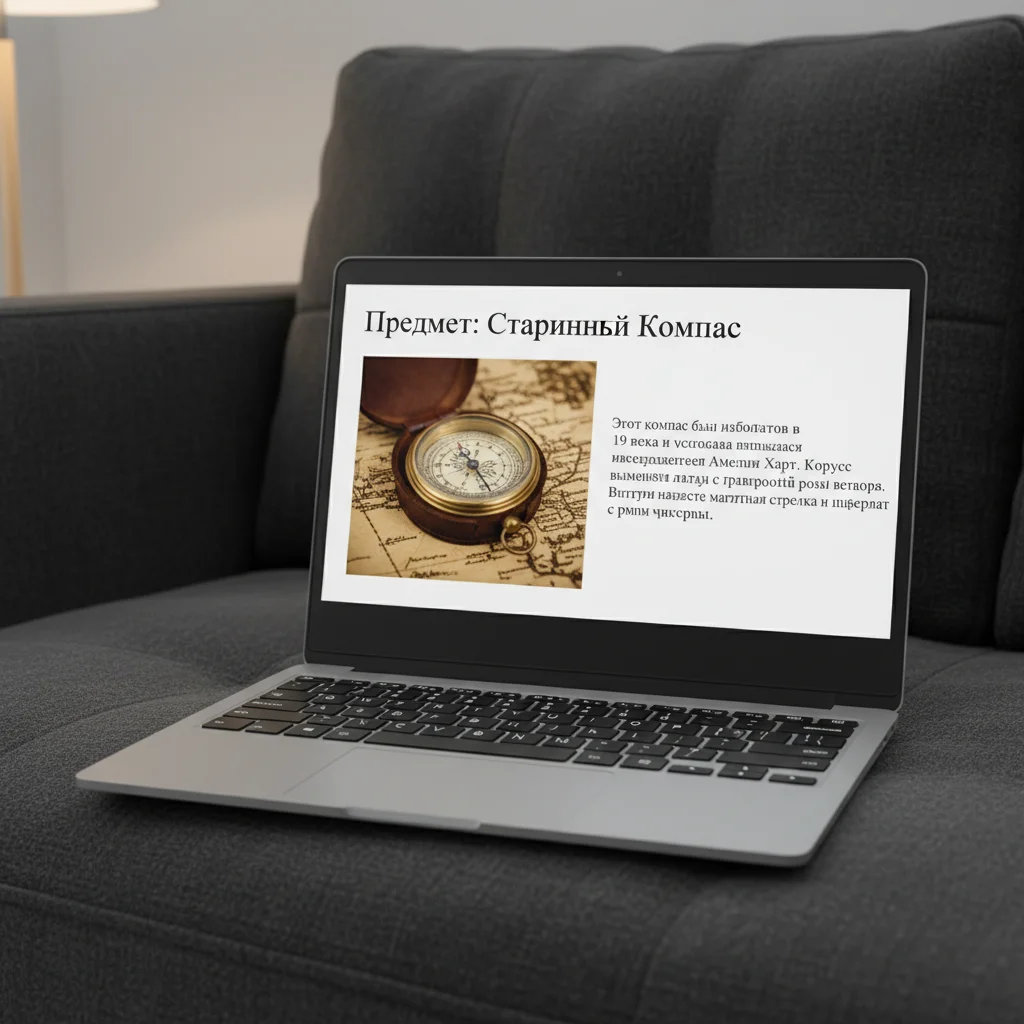
Creating a Description (Inventory). In a text editor (like Word), a document is created with a detailed description of the item: its name, dimensions, weight, materials, and other characteristics. This file is also saved under the inventory number.
Entering into the Catalog. The final step is to enter all the information into a general catalog or database. The record includes the inventory number, photos, a brief description, the date and place of acquisition, the purchase price, and information about the sale (if it occurred), including the date, amount, and invoice number. Such a system allows for quick retrieval of all information about any item in the collection.
Inventory and Record-Keeping System for a Collection