How to Determine Gold Purity at Home: The Hydrostatic Weighing Method
There is a simple method that allows you not only to verify the authenticity of gold but also to determine its purity at home. This method is known as hydrostatic weighing. It doesn't require complex equipment—all you need are accurate scales, a glass of water, a thread, and a piece of paper for notes.
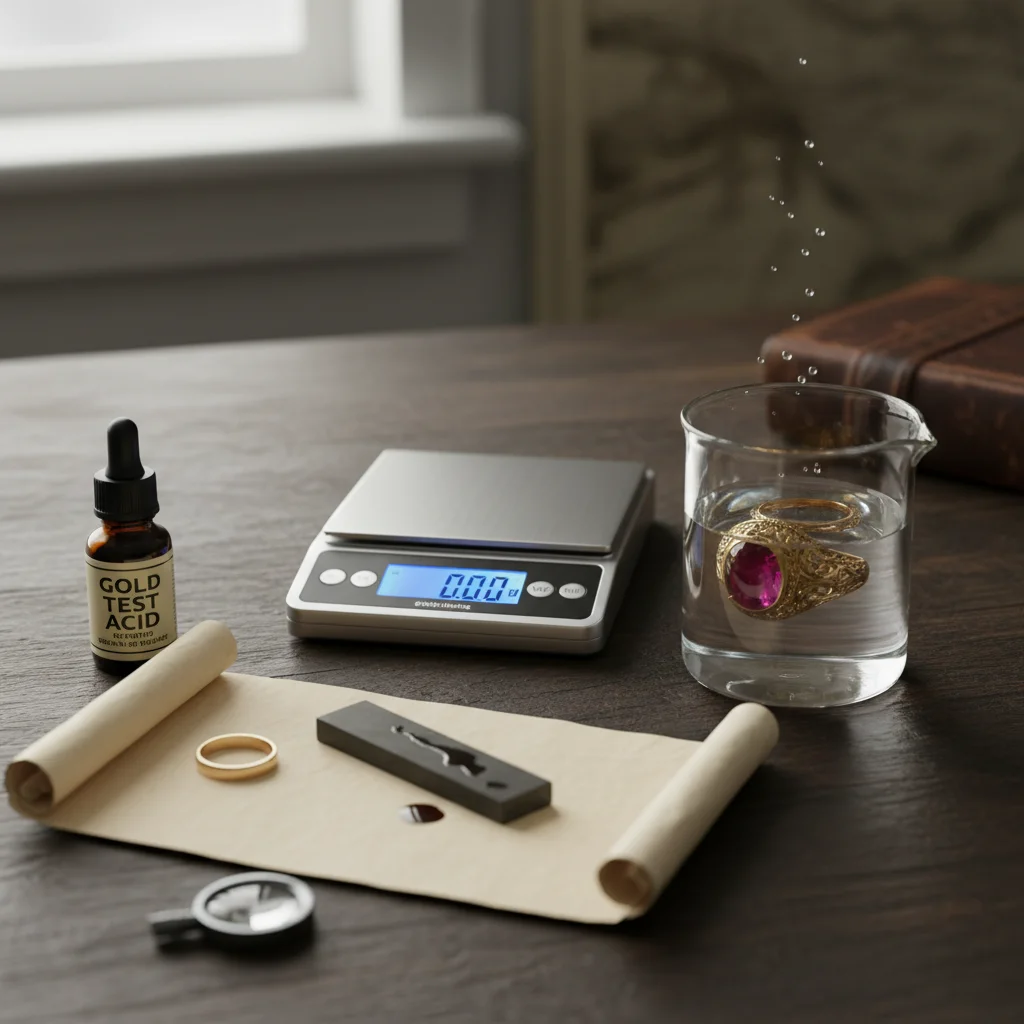
The Principle of Hydrostatic Weighing for Determining Gold Purity
There is a simple method that allows you not only to verify the authenticity of gold but also to determine its purity at home. This method is known as hydrostatic weighing. It doesn't require complex equipment—all you need are accurate scales, a glass of water, a thread, and a piece of paper for notes.
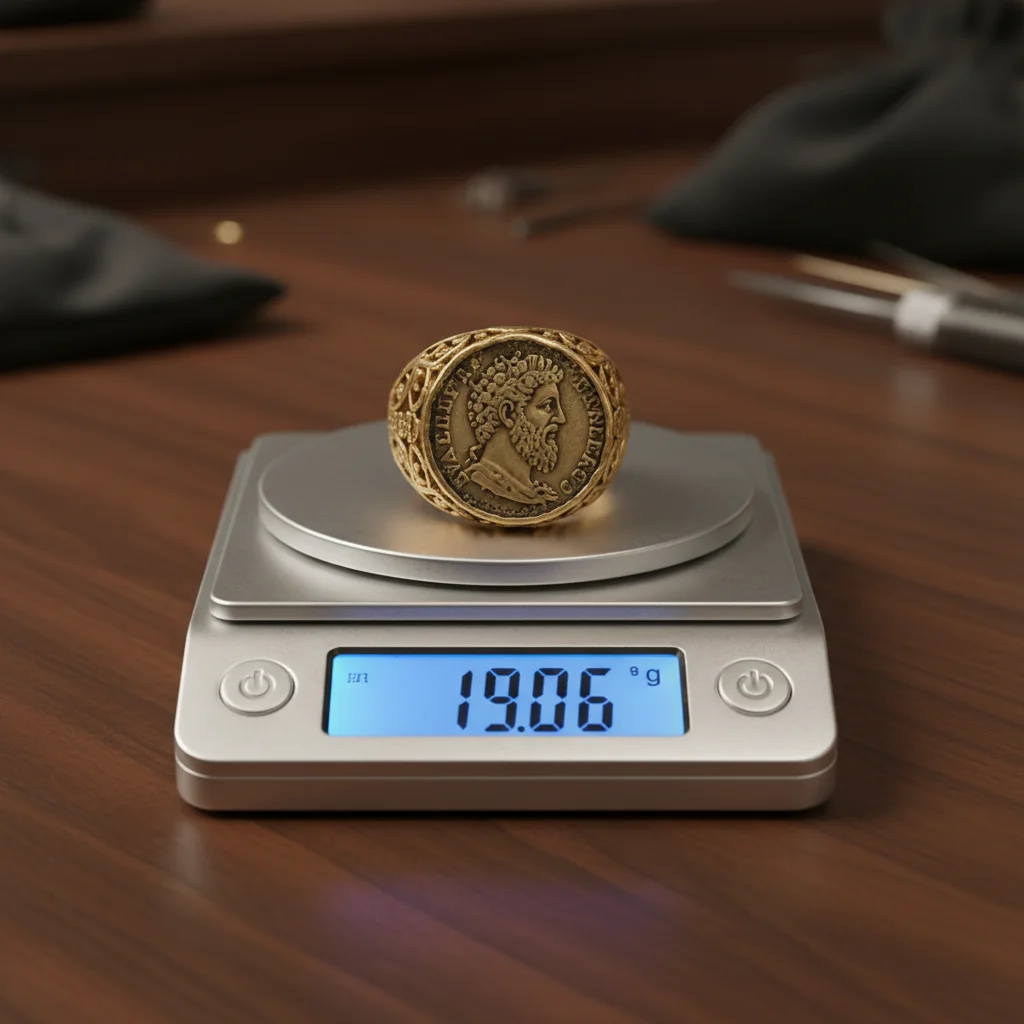
Several items will be used as examples to demonstrate the method. Among them is a signet ring, presumably of 750 purity, with a coin set in it but without a hallmark. A 585 purity ring and a gold element (shtral) from the Order of the Patriotic War, 1st Class, whose purity is also unknown, will also be tested.
Weighing Steps: Measuring Weight in Air and in Water
| Item | Weight in Air (g) |
| Signet ring with coin | 19.06 |
| Ring | 5.26 |
| Shtral from the order | 13.03 |
| Item | Weight in Water (g) |
| Signet ring with coin | 1.28 |
| Ring | 0.40 |
| Shtral from the order | 0.99 |
The first step is to accurately weigh each item in the air. All the data obtained must be carefully recorded for subsequent calculations. This is the base weight that will form the basis for determining the density.
The second step is hydrostatic weighing. To do this, a glass of water is placed on the scale, and then the tare weight is zeroed out. Next, each item is suspended by a thread and fully submerged in the water, without touching the sides or bottom of the glass. The weight shown on the scale is the weight of the displaced water, and this also needs to be recorded.
Calculating Density and Checking Against the GOST Standard
| Item | Density Calculation | Density (g/cm³) |
| Signet ring with coin | 19.06 / 1.28 | 14.89 |
| Ring | 5.26 / 0.40 | 13.15 |
| Shtral from the order | 13.03 / 0.99 | 13.16 |
After obtaining the two weight values (in air and in water), you can calculate the metal's density. The formula is simple: the item's weight in air is divided by its weight in water. The resulting number is the density you are looking for.
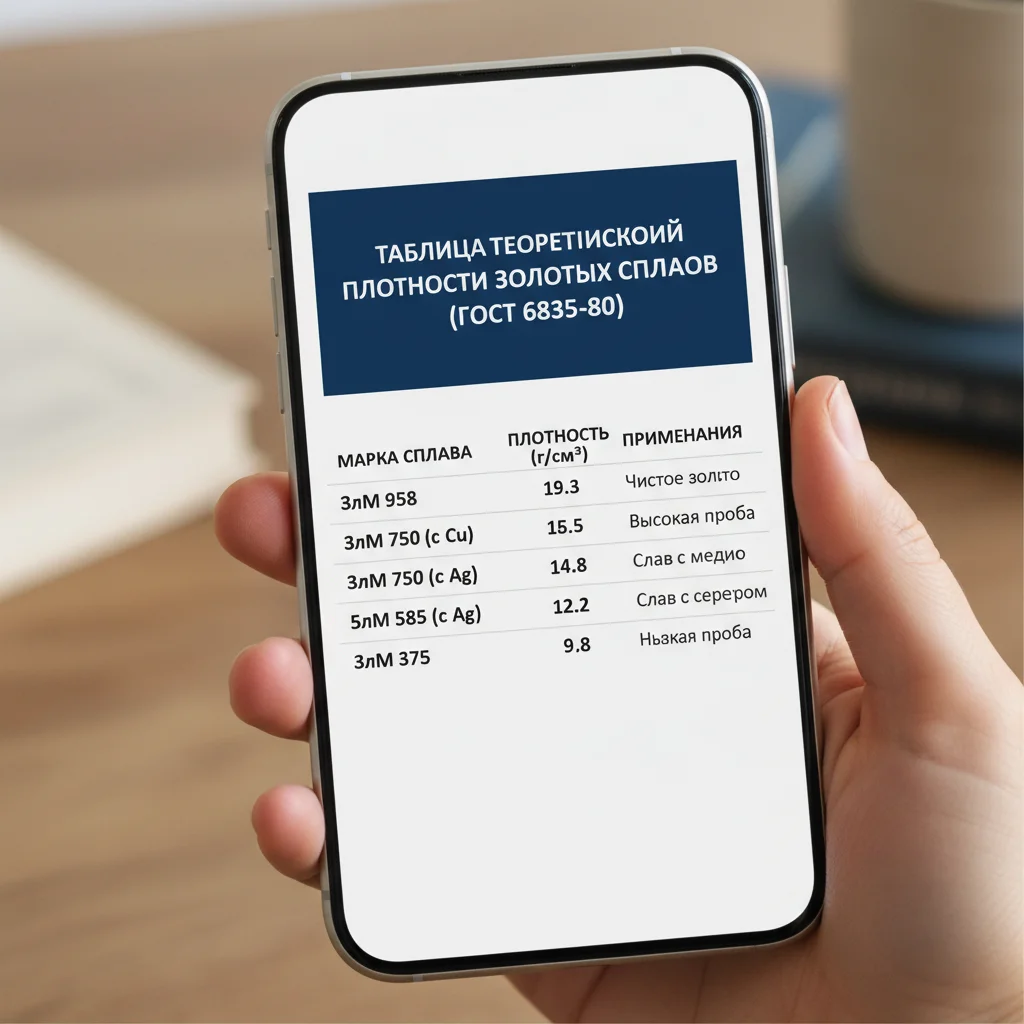
To determine the purity, the obtained density values are compared with the reference data from the GOST 6835-80 table. For the ring with a density of 13.15 g/cm³, the closest value in the table is 13.24 g/cm³, which corresponds to 585 purity gold. The shtral with a density of 13.16 g/cm³ also corresponds to 585 purity.
The signet ring with the coin, composed of 750 and 900 purity alloys, showed a density of 14.89 g/cm³. This result is an average and is less accurate due to the mixing of metals, but it falls within the expected range for high-purity gold alloys (the density for 750 purity is 15.53 g/cm³).
How to Identify a Fake: A Test Using a Counterfeit Signet Ring
The hydrostatic weighing method effectively identifies fakes, even if they have a false purity mark. For demonstration, a signet ring was used that looked like gold and had a '585' stamp.
- Weighing in air: the ring's weight was 15.34 grams.
- Weighing in water: the weight in water was 1.73 grams.
Next, the density was calculated: 15.34 g / 1.73 g = 8.86 g/cm³. A check against the GOST table showed that a density of 8.86 g/cm³ does not correspond to any gold alloy. This clearly indicates that the ring is not gold, despite having a purity mark.
Limitations of the Method: Items with Stones and Alloys
It is important to understand that the hydrostatic method has its limitations. It is not suitable for testing items with precious or semi-precious stones. The density of stones differs from the density of metal, so the weighing result will be distorted and will not allow for an accurate determination of the alloy's purity.
For example, a 585 purity gold ring with a stone was tested. Its weight in air was 7.04 grams, and in water, 0.77 grams. The calculated density was 9.14 g/cm³, which does not correspond to the values for gold at all. This proves that testing items with stones this way is pointless.
It should also be remembered that the method is most accurate for items made of a homogeneous metal. In the case of complex alloys or items composed of several different metals (like the first signet ring with the coin), the measurement error increases.