A Special Feature of Banknote Collecting: Pairs with Consecutive Serial Numbers - AUCBURG | AUCBURG
A Special Feature of Banknote Collecting: Pairs with Consecutive Serial Numbers
One of the interesting features in collecting paper currency, or notaphily, is acquiring banknotes in pairs with consecutive serial numbers. This principle applies to notes with unique sequential numbering, for example, banknotes of Russia and the USSR, starting from the "Shipovshchina" period.
The Collection Principle: Pairs with Consecutive Serial Numbers
One of the interesting features in collecting paper currency, or notaphily, is acquiring banknotes in pairs with consecutive serial numbers. This principle applies to notes with unique sequential numbering, for example, banknotes of Russia and the USSR, starting from the "Shipovshchina" period.
This approach excludes certain types of currency, such as "pyatakovki" or "sovznaki," which lacked unique numbering. Although this specialty might seem strange at first glance, for some collectors, it becomes a fundamentally important and interesting aspect of the hobby.
How It All Began: A Pair of Soviet Rubles
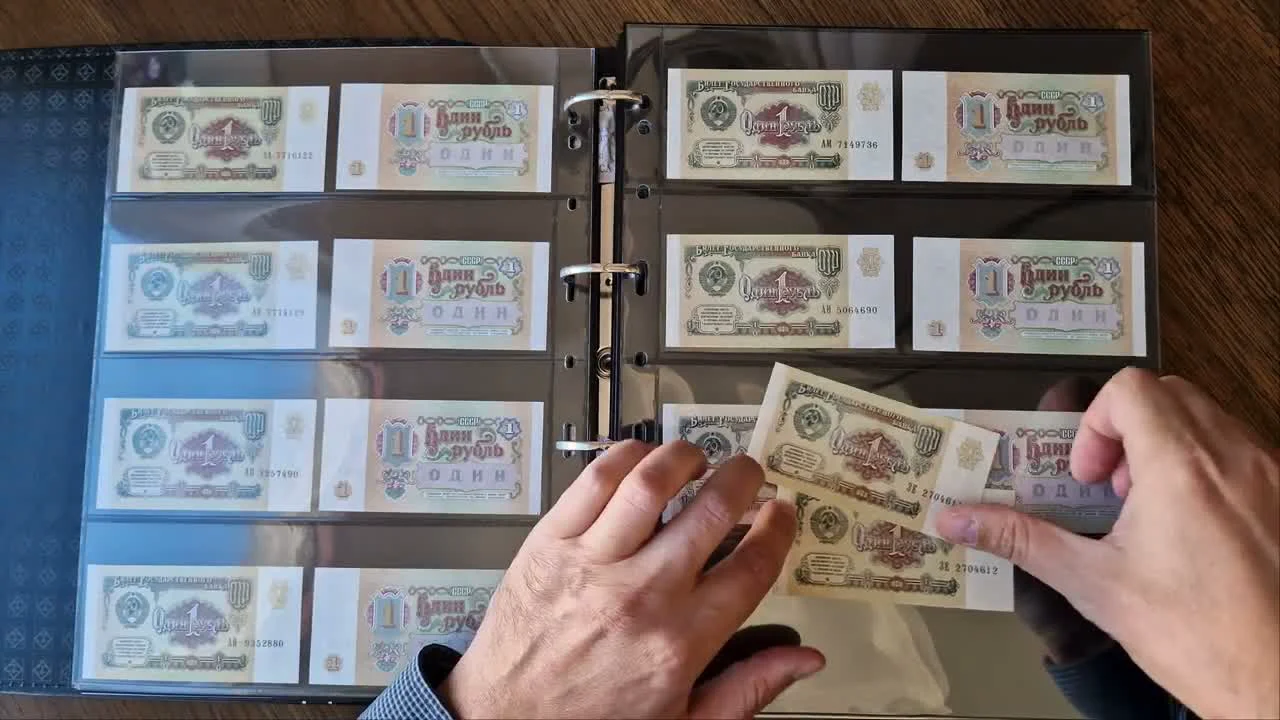
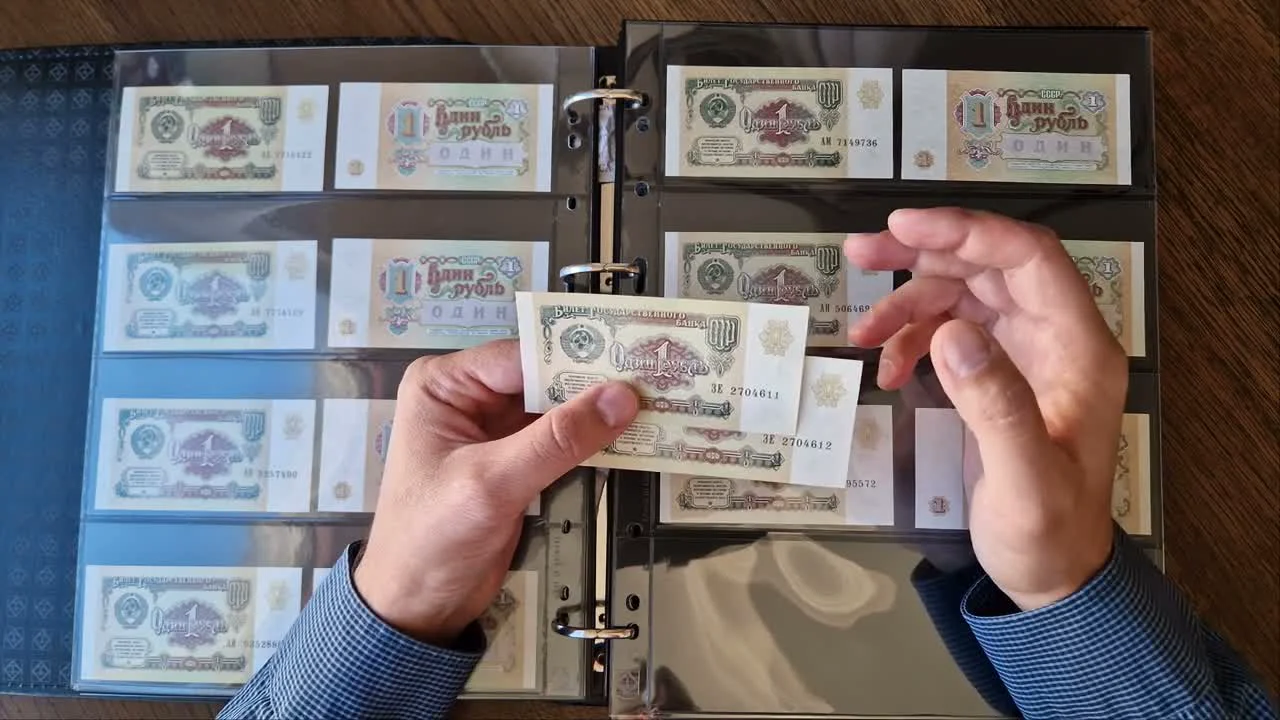
The passion for collecting banknote pairs can start with a chance find. For example, the story of this collection began in 1991 with a pair of one-ruble notes given to a child by their parents. These were banknotes with serial numbers M 2704611 and M 2704612.
It was then that the realization came that money is printed, packed into bundles and straps, and its numbering is sequential. This pair of rubles has been preserved since childhood, and although it is not in perfect condition (about XF, not UNC) due to improper storage, it became the starting point for the entire hobby.
Unlike coins, which are not numbered, paper money has a unique serial number. This fundamentally distinguishes notaphily from numismatics and makes this type of collecting possible.
How It All Began: A Pair of Soviet Rubles
Examples from the Collection: Banknotes of the USSR and Russia
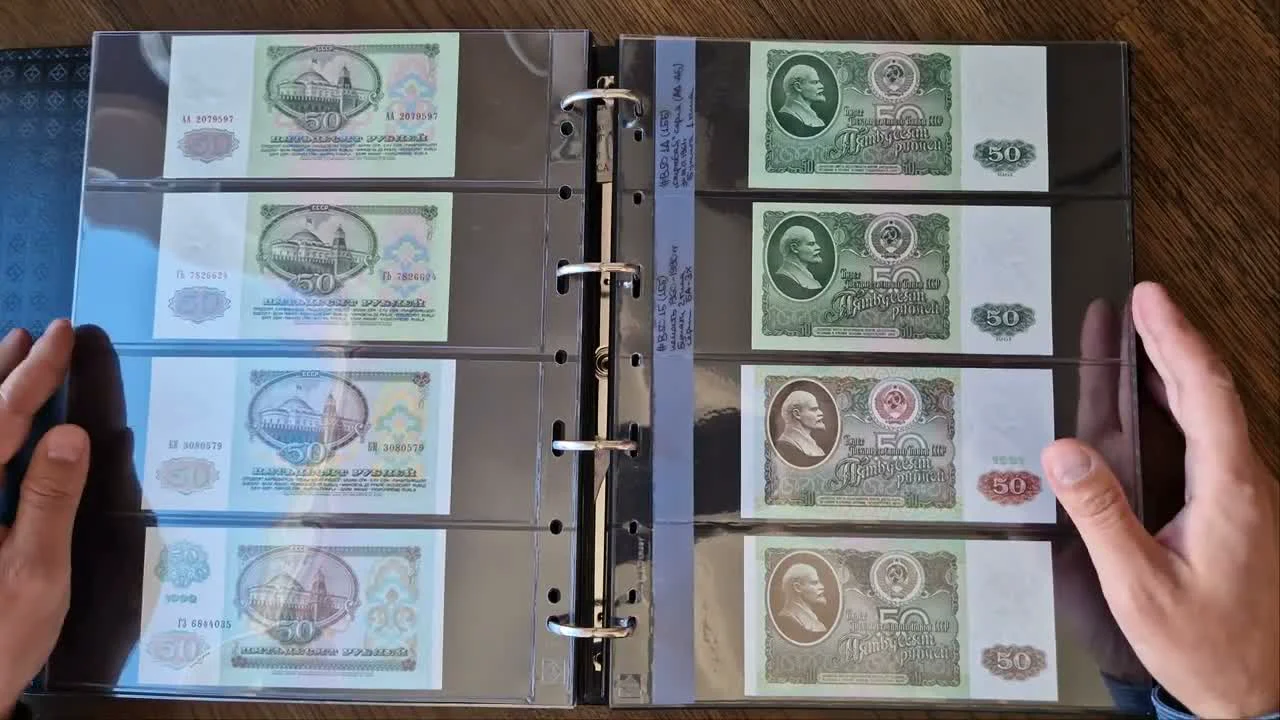
The principle of collecting in pairs can be illustrated with banknotes from the USSR and early Russia. In an album with notes from 1961-1991, you can see how this approach is applied to different denominations and issues.
For example, there are pairs of 50-ruble banknotes from the first issue of the AA series, as well as the second type (according to the Zasko classification). The same principle is followed for banknotes from 1991 and 1992.
The 1993 banknote collection also includes paired examples, covering various variations. Among them are 100-ruble notes on white and gray paper, with large and small series letters, as well as 500-ruble banknotes.
Examples from the Collection: Banknotes of the USSR and Russia
"Hoard" Finds and Their Value
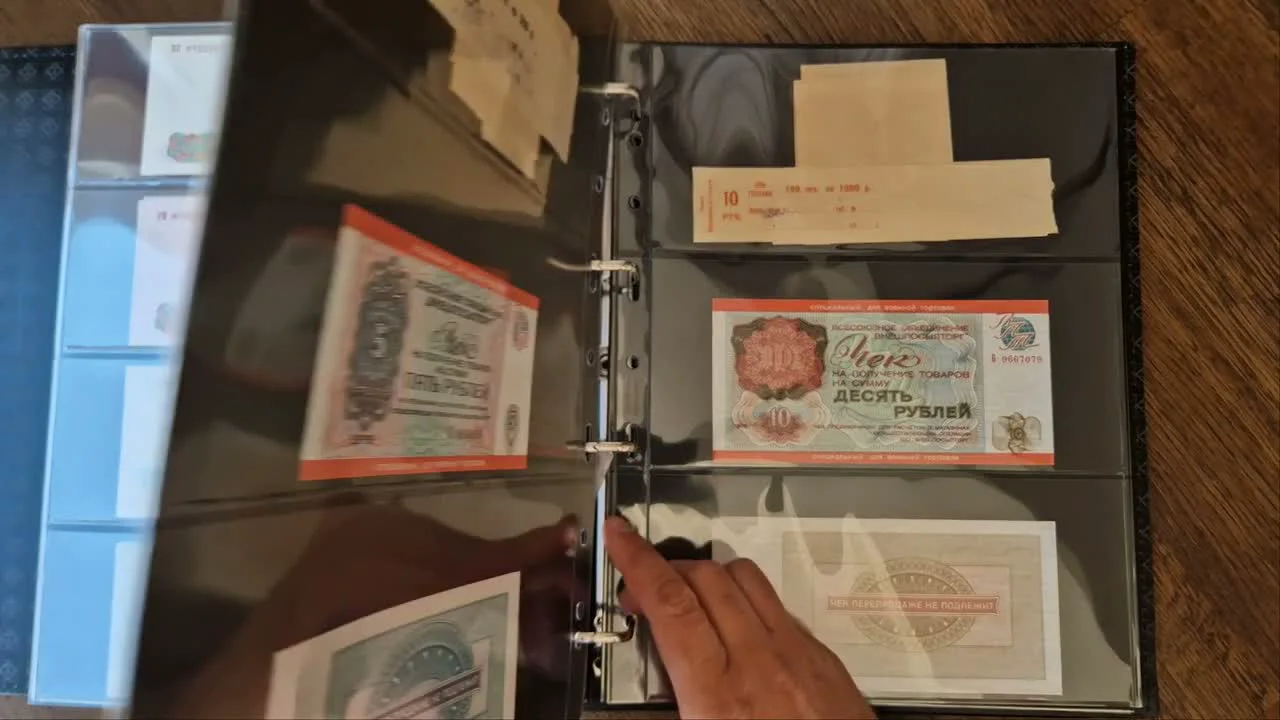
Of particular interest to collectors are so-called "hoard" finds, where a large number of uncirculated banknotes are discovered, often in bank wrappers. Such finds make it much easier to find pairs with consecutive numbers.
An example would be military checks found in Central Asia. From such a "hoard," it was possible to acquire not only pairs of checks with denominations of 10, 20, and 50 rubles, but also the original packaging bands from the straps. These bands serve as additional confirmation that the banknotes came from the same bundle.
"Hoard" Finds and Their Value
Banknotes of Tsarist Russia: "Shipovshchina"
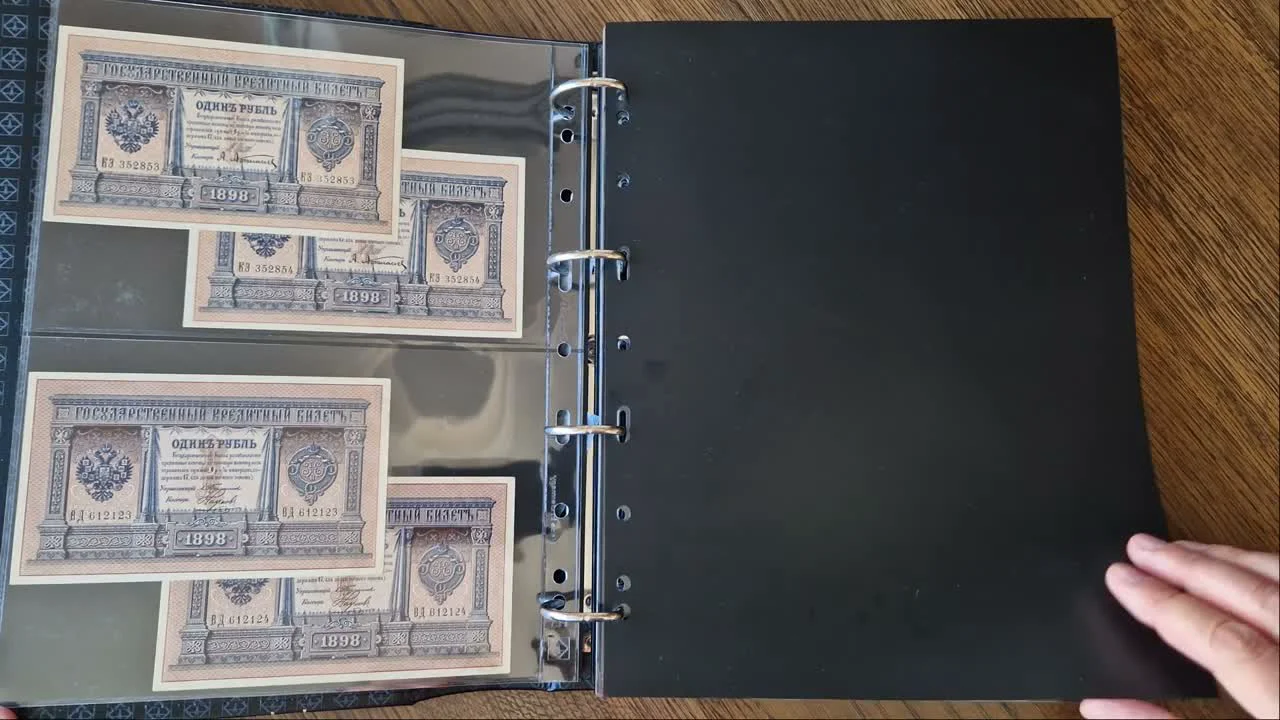
Collecting banknote pairs also extends to earlier periods, such as the state credit notes from the time of Nicholas II. This period in notaphily is known as "Shipovshchina," named after the manager of the State Bank, I. P. Shipov.
Finding pairs of banknotes from this era is more difficult, but possible. The collection includes pairs of one-ruble notes from 1898 with the signatures of Shipov and cashier Afanasyev, as well as with the signatures of Timashev and Naumov. A pair of three-ruble banknotes with the signatures of Shipov and Konshin is also shown, one of which has an interesting number starting with two zeros.
Banknotes of Tsarist Russia: "Shipovshchina"
Interesting Finds: Fancy Numbers and Printing Errors
The search for banknote pairs sometimes leads to the discovery of specimens with special features. These can be banknotes with "fancy" numbers as well as examples with printing errors.
One example is a pair of 5-ruble banknotes where one has a "radar" number 700707, and the second has the next sequential number, 700708. Such combinations are particularly valued by collectors.
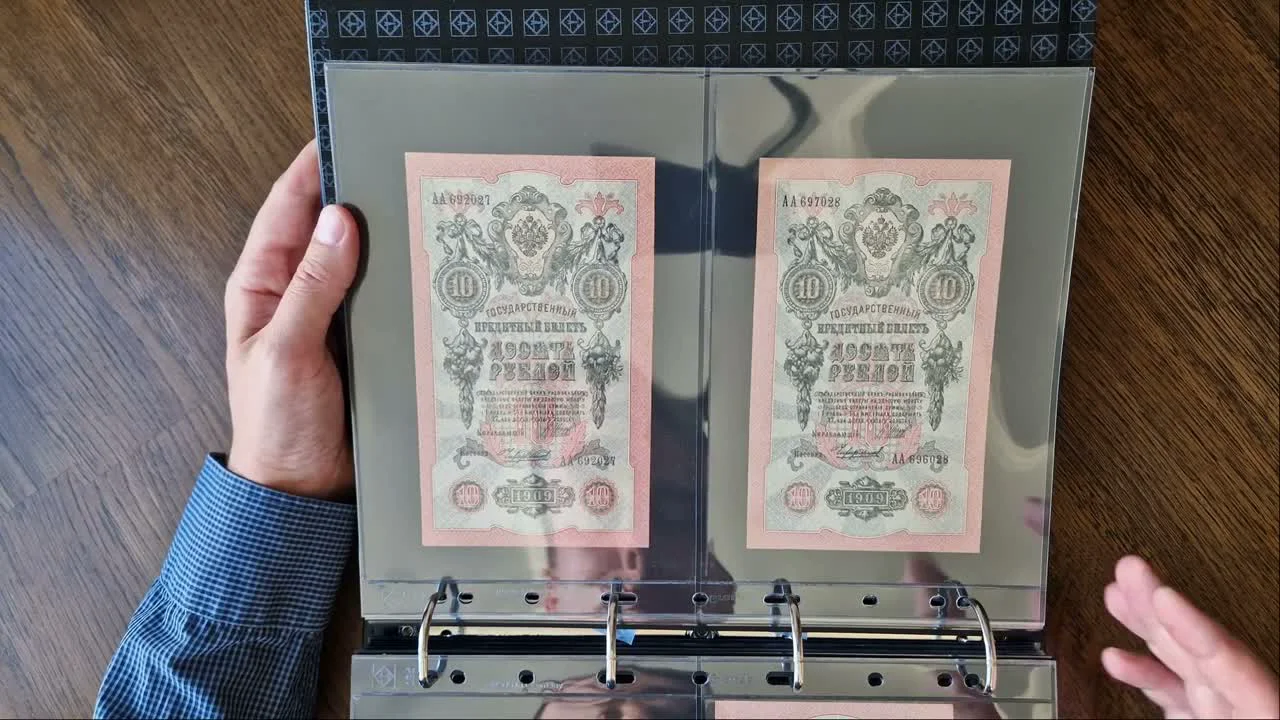
Another interesting case is a pair of 10-ruble banknotes from the AA series with a numbering machine malfunction. Due to a mechanical error, the numbers on two consecutive notes were not sequential. Moreover, on one of the banknotes, the numbers on the front and back sides differ, which is a rare type of error.
Interesting Finds: Fancy Numbers and Printing Errors
Collection Systematization and Priorities
To systematize the collection, especially for the "Shipovshchina" period, collectors use specialized literature. For example, the catalog "Credit Notes of Nicholas II" by Fedotov helps determine the rarity of banknotes based on the signatures of the managers (Shipov, Konshin, Timashev) and cashiers (Ivanov, Metz, etc.).
With this approach to collecting, priorities can shift. Sometimes, having a pair of banknotes with consecutive numbers becomes more important than perfect (UNC) condition. A pair of banknotes, even with slight signs of circulation, can be more valuable to a personal collection than a single perfect note, as it carries the history of its origin from the same bundle.