Autograph Authentication: How Not to Buy a Signature Made Yesterday - AUCBURG | AUCBURG
Autograph Authentication: How Not to Buy a Signature Made Yesterday
At the heart of autograph expertise lies a detailed graphological analysis. Specialists don't just look at the similarity of letters; they study micro-characteristics that are nearly impossible to forge. Key attention is paid to three main aspects: pressure, dynamics, and writing speed.
Handwriting Analysis: The Three Pillars of Authenticity
At the heart of autograph expertise lies a detailed graphological analysis. Specialists don't just look at the similarity of letters; they study micro-characteristics that are nearly impossible to forge. Key attention is paid to three main aspects: pressure, dynamics, and writing speed.
A genuine signature made by a person will always have uneven pressure. In some places, the line will be thicker, in others, thinner—this reflects the natural movement of the hand. Forgeries, especially those executed slowly and carefully, often give themselves away with a monotonous, 'dead' pressure.
Dynamics and speed are another important marker. A real autograph is usually made quickly, confidently, and smoothly. This creates a living, continuous line. A forged signature often looks hesitant, with small stops and tremors that betray the forger's uncertainty as they try to copy someone else's handwriting. Key characteristics for analysis include:
Pressure: variation in the thickness and intensity of the line.
Speed: the smoothness and swiftness of the stroke.
Rhythm: the natural sequence of movements.
Slant: consistency or natural variation in the angle of the letters.
Letter connections: unique ligatures characteristic of a specific person.
Ink Composition: A Journey Through Time
If graphological analysis raises doubts, chemical ink analysis comes to the rescue. This method can determine with high accuracy when a signature was made. The composition of ink has changed over time, and the use of modern materials on an old document is a sure sign of a forgery.
For example, ballpoint pens became widespread only after World War II. An autograph of a 19th-century historical figure made with such a pen is obviously a fake. The same applies to felt-tip or gel pens, which appeared even later.
Experts use non-destructive analysis methods, such as spectroscopy, to determine the chemical composition of the pigment and binder. This not only helps to identify anachronisms but also allows for comparing the ink with samples from a specific period. Thus, autograph authentication often turns into a real historical investigation.
Ink Composition: A Journey Through Time
Autopen and Secretarial Signatures: Hidden Threats
Comparison with reference samples, analysis of speed and rhythm
Autopen
Uniform pressure, lack of a 'live' line, identical copies
Overlaying several signatures, absence of start and end stroke marks
Secretarial
Made by a live hand, but with minor stylistic differences from the original
Careful comparison with confirmed originals, searching for uncharacteristic elements
Not all non-genuine autographs are the work of forgers. Mechanical or so-called 'secretarial' signatures are common, and they also have no collectible value. Understanding their characteristics helps avoid buying a worthless item.
An autopen is a device that mechanically reproduces a signature using a real pen. Such signatures were often used by politicians, astronauts, and stars for mass mailings. The main sign of an autopen is the perfect identity of multiple copies and a uniform, lifeless pressure.
Secretarial signatures are autographs made by assistants on behalf of a famous person. They are done by a live hand, but not the one whose name is indicated. They are harder to recognize as they can be very similar to the original. Comparison with known authentic examples helps here, revealing the smallest but consistent discrepancies in style.
Autopen and Secretarial Signatures: Hidden Threats
Certificate of Authenticity (COA): Trust, but Verify
A Certificate of Authenticity (COA) is a document that should confirm that an autograph is genuine. However, the value of the certificate itself depends directly on the authority of the organization or expert who issued it. Unfortunately, there are many worthless COAs on the market, printed by the sellers themselves.
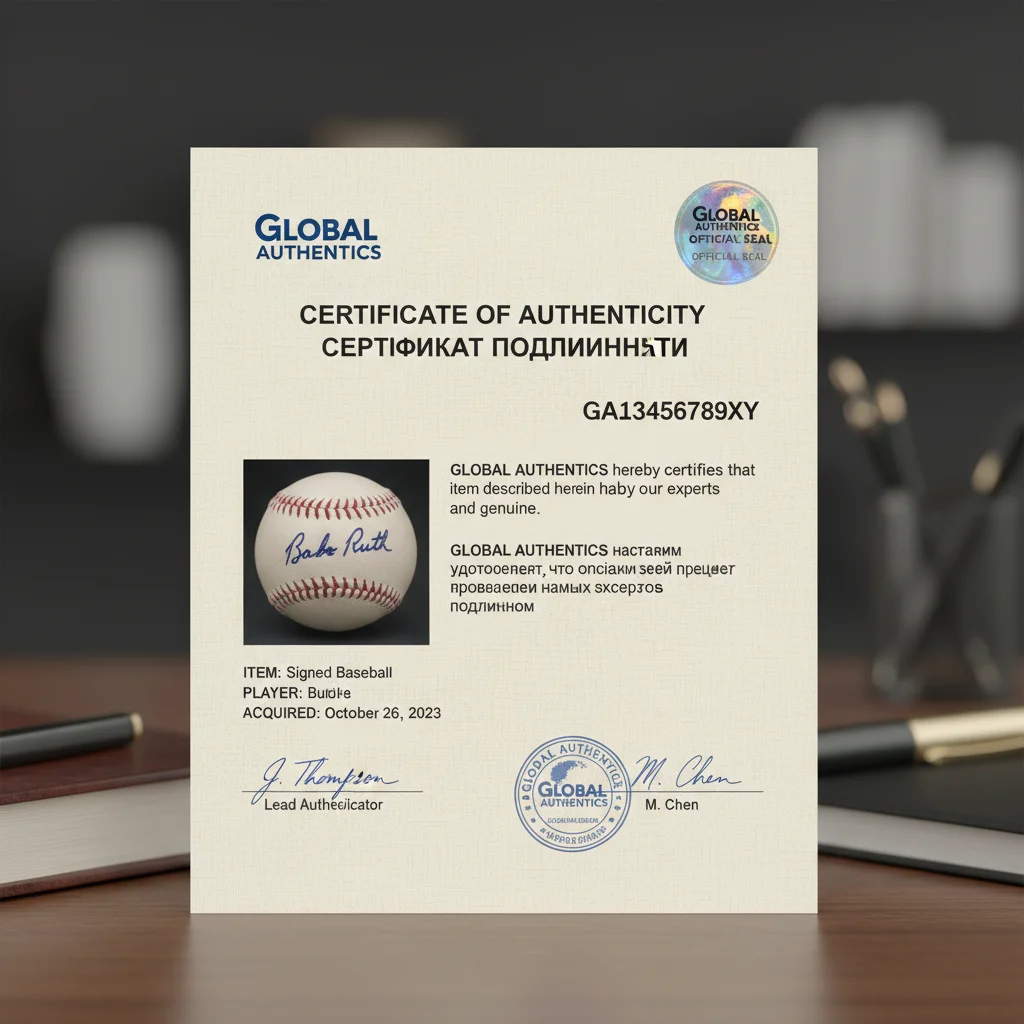
A reliable certificate is not just a pretty piece of paper. It must contain important information that allows its legitimacy to be verified. When buying an autograph with a COA, it is important to pay attention to the reputation of the authenticator. Leading global companies such as PSA/DNA, JSA, or Beckett Authentication Services have extensive databases and are trusted by collectors.
To avoid being deceived, you should check what elements the certificate contains. A good COA should include:
A clear image of the autographed item.
A unique serial number that can be verified in the authenticator's online database.
Full contact details and the name of the authenticating company.
Often — a holographic sticker with the same number, placed on the item itself.
The absence of these elements or a certificate issued by an unknown company should be a serious reason to doubt the autograph's authenticity.