Preparing Coins for Sale: Creating an Inventory Spreadsheet - AUCBURG | AUCBURG
Preparing Coins for Sale: Creating an Inventory Spreadsheet
Before coins are listed for sale online, the final preparations must be completed. By this point, the seller should already have their starting assets established—the coin collection itself, ready for sale.
Before coins are listed for sale online, the final preparations must be completed. By this point, the seller should already have their starting assets established—the coin collection itself, ready for sale.
You also need a folder with high-quality, processed photos of each specimen, saved on your computer or phone. Additionally, you should register in advance on several key online trading platforms and in specialized social media groups.
The Sales Spreadsheet: The Main Record-Keeping Tool
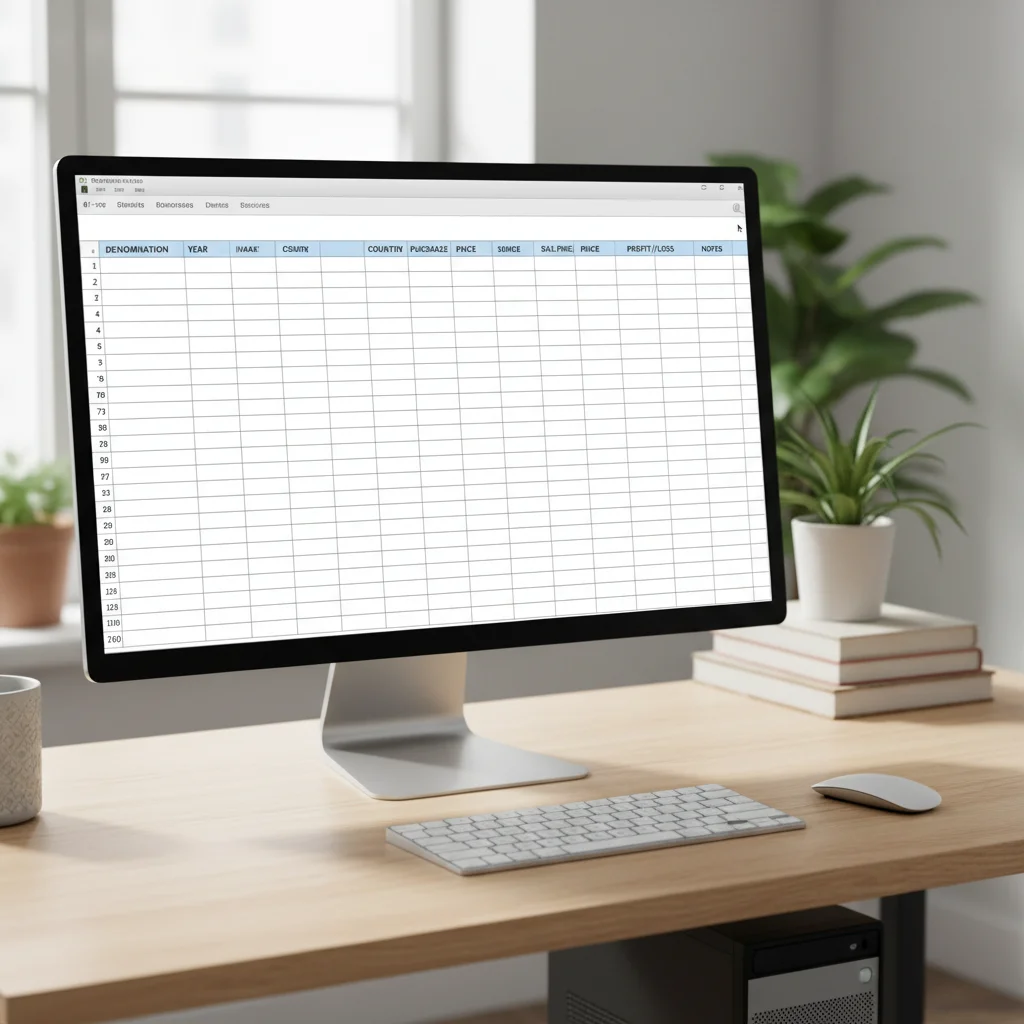
A key step in the preparation is creating a sales spreadsheet. You can use any spreadsheet editor for this, such as Excel, OpenOffice, or another equivalent. This file will become the main document for internal bookkeeping and tracking all transactions.
Such a spreadsheet allows you to systematize all information about the coins, track their movement, costs, and final profit. The structure of the spreadsheet can be arbitrary, but there is an optimal format that includes all the necessary columns for your work.
The Sales Spreadsheet: The Main Record-Keeping Tool
Structure of the Inventory Spreadsheet
Column
Content and Purpose
Numbering
A sequential number for each coin. Helps distinguish between specimens of the same type but with different purchase prices.
Name
Basic data in one cell: denomination, year, country, and mint.
Description
Full characteristics: metal, weight, catalog numbers (Bitkin, Dyakov, Uzdenikov), condition, and any defects (weak strike, lamination, residual luster). This description will be copied for lot listings.
Acquisition Cost
The price for which the coin was purchased. If the price is unknown, a dash is entered.
Price
The desired selling price. It is set after a preliminary analysis of market prices.
Final Sale Price
The total sale amount including all expenses: shipping, promotional options, discounts.
Note
The current status of the coin: submitted to auction, on hold, on consignment with another dealer, or on a payment plan with a client.
For effective record-keeping, it is recommended to create a spreadsheet with the following columns. Each of them performs an important function and helps avoid confusion, especially when working with a large number of similar coins.
A detailed and knowledgeable description in the corresponding column increases the buyer's trust, as it demonstrates the seller's professionalism.
Structure of the Inventory Spreadsheet
Pricing Strategy
Once the spreadsheet is ready, you can begin filling it out and determining prices. The pricing strategy depends on the category to which the coin belongs. They can be conditionally divided into three groups.
The 'Why Did I Buy This?' Category. For such coins, it's worth setting a price below the market rate. The buyer will be asking themselves the same question, and the price will be the deciding factor for them. It's better to use the proceeds to acquire higher-quality material.
The 'I'd Replace It Someday' Category. These coins should be priced at the average market rate with a small discount of 3-5%. This will make the offer competitive and attractive to buyers.
The 'Never For Sale' Category. Even such valuable specimens are worth listing for sale. You can set a deliberately high price—if the coin sells, the proceeds will allow you to purchase an even better quality equivalent. Moreover, having such lots in a seller's profile works as an advertisement, showcasing beautiful, high-quality items and enhancing their reputation.