All About Gold and Silver Investment Coins - AUCBURG | AUCBURG
All About Gold and Silver Investment Coins
An investment coin is a special type of coin issued by central banks. Their main purpose is for investment and creating a personal savings fund. Unlike regular money, their value is determined not by their face value, but by their precious metal content.
A coin made of precious metal, intended for creating a personal savings fund.
An investment coin is a special type of coin issued by central banks. Their main purpose is for investment and creating a personal savings fund. Unlike regular money, their value is determined not by their face value, but by their precious metal content.
Gold
Silver
Platinum
Palladium
Each such coin has a monetary denomination (for example, 3, 50, or 100 rubles) and is legal tender in the Russian Federation. Theoretically, you could use it to pay in a store at its face value, but it's not advisable, as its real value, determined by the metal, is much higher.
Weight and Fineness: Key Characteristics
Investment coins, like bullion bars, vary in the weight of the precious metal they contain. The unit of measurement for the weight of precious metals is the troy ounce, which is equal to 31.1 grams.
3.11 g (1/10 ounce)
7.78 g (1/4 ounce)
15.55 g (1/2 ounce)
31.1 g (1 ounce)
It is important to understand that the actual physical weight of the coin is slightly more than the weight of the pure precious metal in it. This is because the fineness of the metal in coins is typically 999, not 999.9 as in bullion bars. For example, a coin containing 7.78 grams of pure gold will weigh 7.88 grams on a scale.
Weight and Fineness: Key Characteristics
The 'George the Victorious' Gold Coin
Investment coins are minted at mints; in Russia, these are the Moscow (MMD) and St. Petersburg (SPMD) mints. The most popular gold coin is the 'George the Victorious'.
The coins are sold in special sealed capsules. These capsules have small tamper-evident seals around the perimeter that break when opened. This allows one to determine if the capsule has been opened.
The obverse of the coin depicts George the Victorious on horseback, slaying a dragon with a spear. The reverse features the double-headed eagle, the inscriptions 'Russian Federation', 'Bank of Russia', the face value (e.g., 50 rubles), the year of issue, as well as the fineness (Au 999), the weight of the pure metal (7.78), and the mint mark (MMD or SPMD).
The 'George the Victorious' Gold Coin
Thematic and Historical Gold Coins
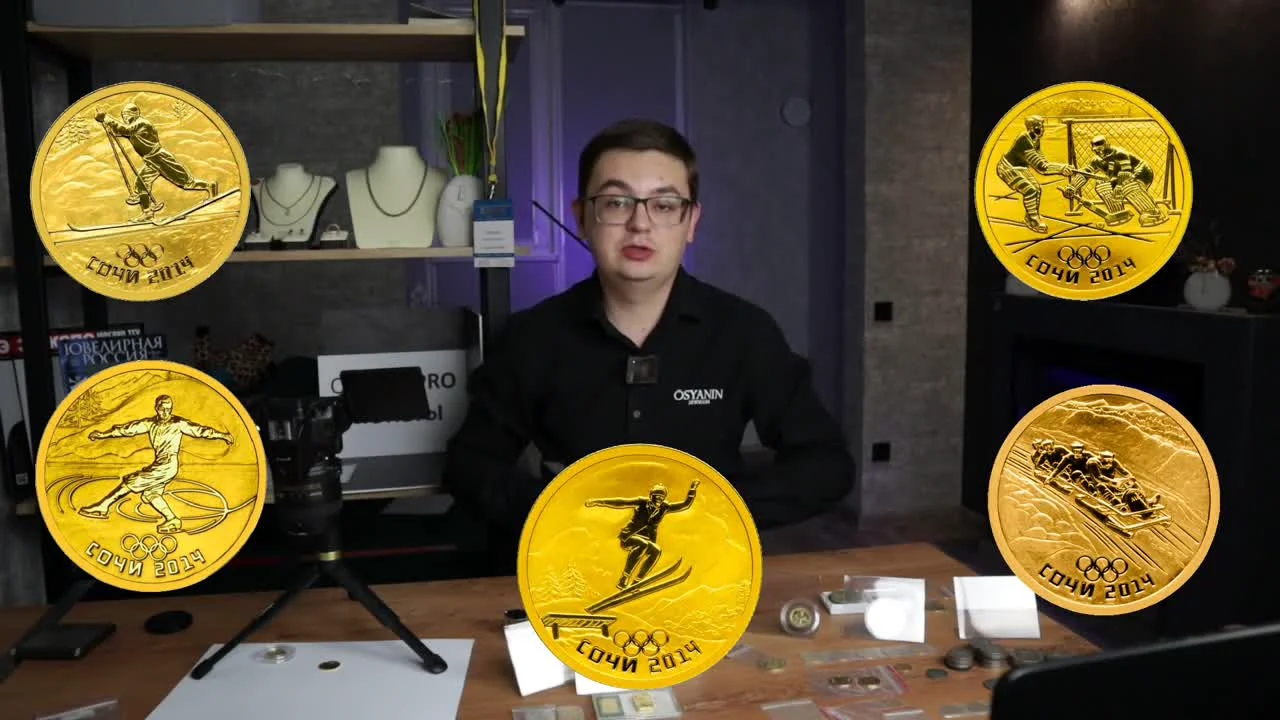
Besides 'George the Victorious', there are other gold coins. For example, for the 2014 Sochi Olympics, a series of coins was issued depicting various sports: curling, cross-country skiing, and figure skating. The reverse of these coins is identical to the 'Victorious', but the obverse is thematic.
A special place is held by the famous 'Sower' (gold chervonets). This is the only coin from the USSR era (1980 issue) that can still be purchased in banks. The obverse depicts a peasant sower against a backdrop of a plow and factories, and the reverse shows the coat of arms of the RSFSR and the slogan 'Workers of the world, unite!'.
In 2023, for the 100th anniversary of the first issue, the Bank of Russia released a jubilee 'Sower'. The image on it is more detailed, and the reverse features the modern coat of arms of the Russian Federation and a face value of 10 rubles.
Thematic and Historical Gold Coins
Overview of Silver Coins
Among silver coins, 'George the Victorious' is also the most popular. It is larger than its gold counterpart and contains one ounce (31.1 g) of 999 fineness silver. The face value of such a coin is 3 rubles.
There are other silver coins as well. For example, the 'Sable' from 1995. The obverse of this coin depicts a sable, and the reverse features the double-headed eagle of the Bank of Russia's design from that time. The silver fineness here is 925.
Commemorative silver coins are also issued, for instance, from the 'Cities of Russia' series. An example is the coin dedicated to Ryazan, featuring an image of the Ryazan Kremlin. Such coins are considered more commemorative than purely for investment.
Overview of Silver Coins
Coins of the USSR and Tsarist Russia
In addition to modern coins, historical ones are also of interest. Among the silver coins of the USSR era, one can highlight the 'one poltinnik' from 1925 with the image of a blacksmith and the 'one ruble' from 1924 with a star or two workers.
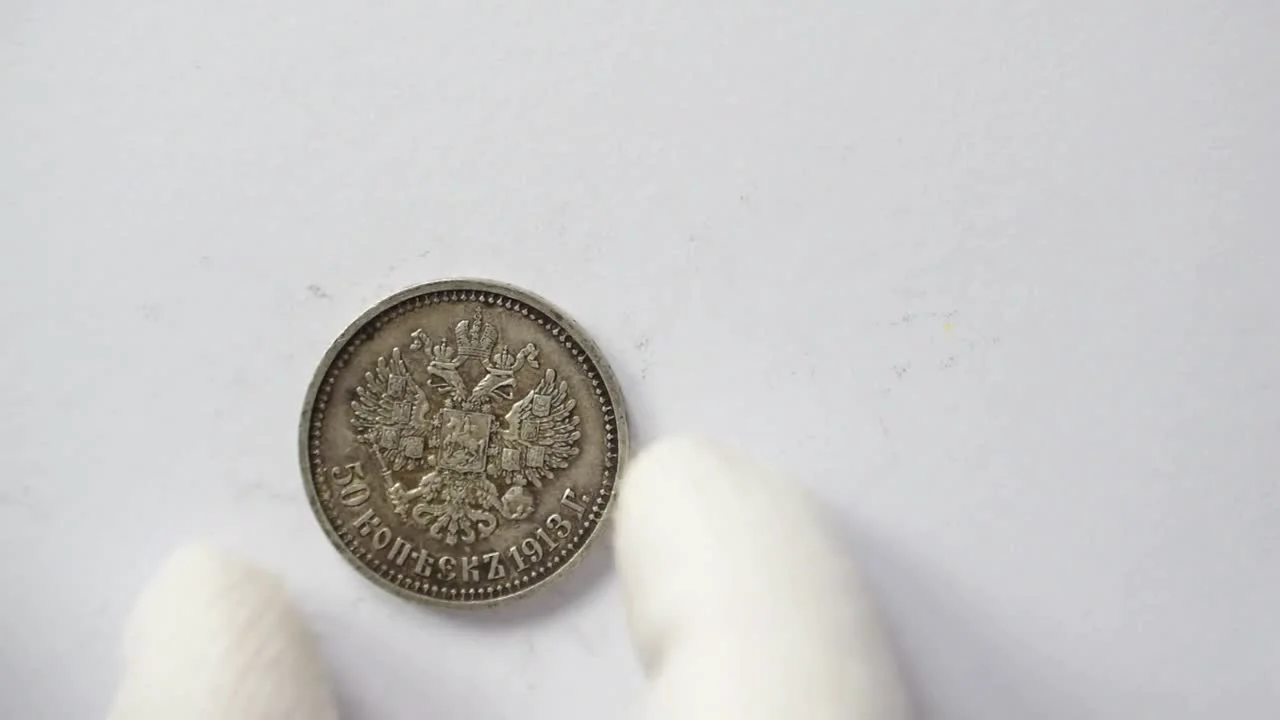
Silver 50 kopeks and 1 ruble coins from the time of Nicholas II.
Silver 50 kopeks coins from the time of Alexander III.
Gold coins of Nicholas II with denominations of 5 and 10 rubles. Due to mass production, their value is close to the price of the metal.
A 5 ruble gold coin from 1876, from the time of Nicholas I, on which the weight is indicated in the old Russian system of measures: 'PURE GOLD 1 ZOLOTNIK 39 DOLYA'.
Coins of the USSR and Tsarist Russia
How and Where to Purchase Investment Coins
Any individual can buy investment coins by presenting a passport. The main places of sale are commercial banks and some other credit institutions.
All modern investment coins are sold in special plastic capsules. It is strongly not recommended to remove the coin from the capsule, as this can affect its condition and reduce its value upon resale, especially if you plan to sell it back to a bank.
Buying coins from advertisements or from private sellers is not recommended. There is a high risk of encountering a counterfeit, so it is safer to deal with official organizations.