Signs of Fake Hallmarks on Antique Silver: A Complete Guide - AUCBURG | AUCBURG
Signs of Fake Hallmarks on Antique Silver: A Complete Guide
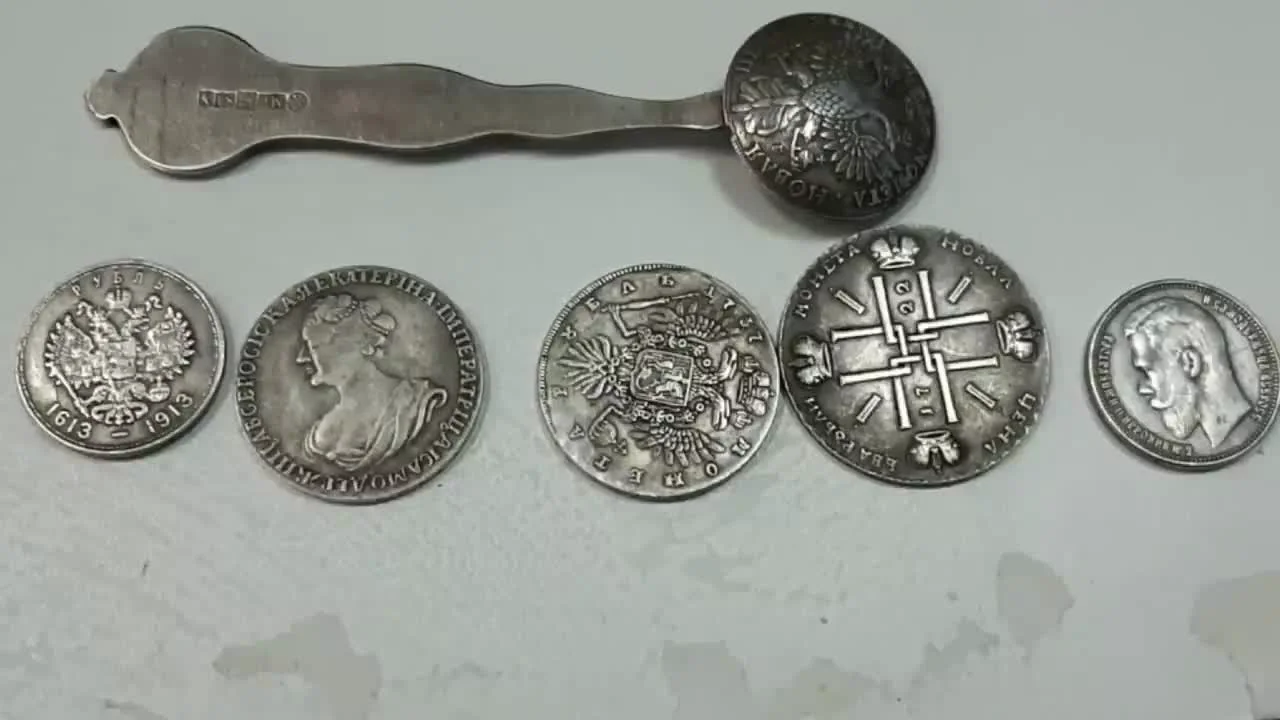
The modern antique market is flooded with fake items. This problem has become particularly acute after a more than 15-year epidemic of counterfeit rare silver coins of the Russian Empire. When the demand for fake coins dropped, their manufacturers switched to producing counterfeit tsarist spoons with 84 zolotnik hallmarks.
The Forgery Epidemic: From Coins to Tsarist Spoons
The modern antique market is flooded with fake items. This problem has become particularly acute after a more than 15-year epidemic of counterfeit rare silver coins of the Russian Empire. When the demand for fake coins dropped, their manufacturers switched to producing counterfeit tsarist spoons with 84 zolotnik hallmarks.
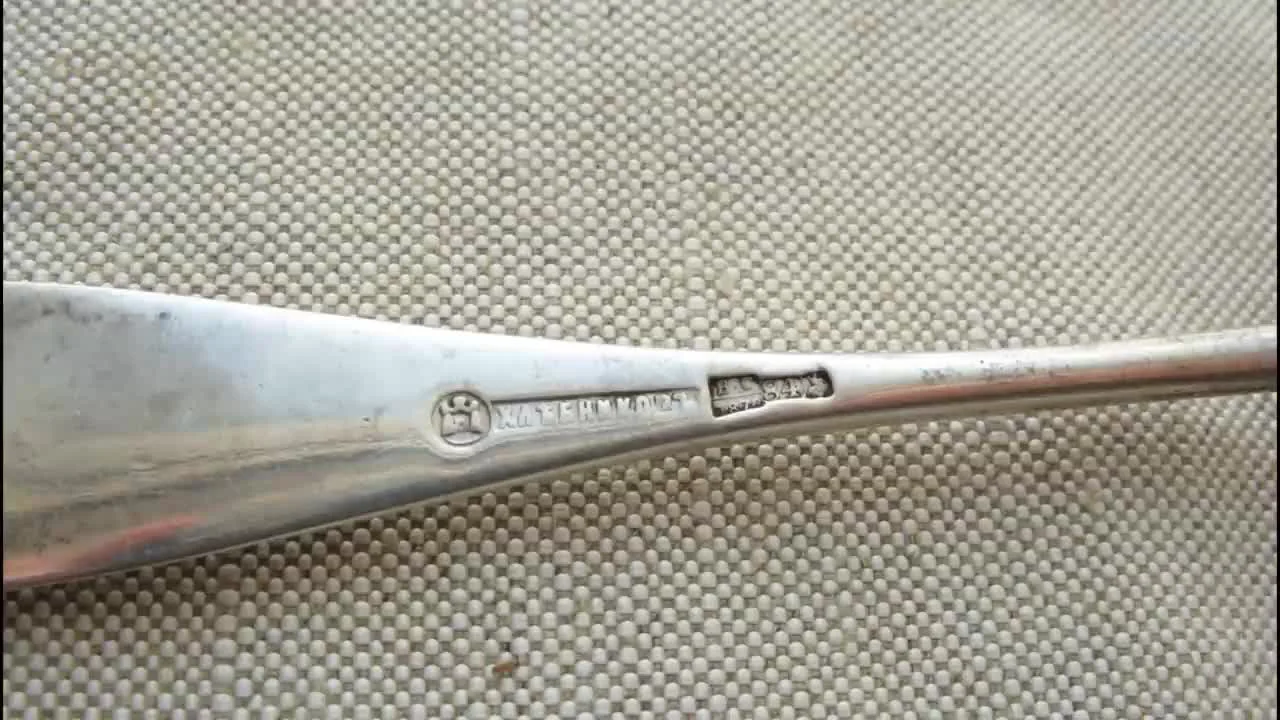
For the average person, the number 84 and dealers' stories about the 'tsarist silver standard' had a hypnotic effect. Elaborate hallmarks and maker's marks with the names of famous masters, such as Fabergé, generated additional interest and inflated prices. As a result, buyers began to regularly purchase forgeries, which are known in slang as 'fufloriat'.
Producers of fake antiques mass-produced these items, actively using the names of famous Russian jewelers to give their forgeries an appearance of authenticity.
Obvious Mistakes: Mismatched Dates and Maker's Marks
In an effort to reduce costs, forgers often treat hallmarks carelessly and make crude mistakes that are easy to spot with historical knowledge. Such inconsistencies are a sure sign of a forgery.
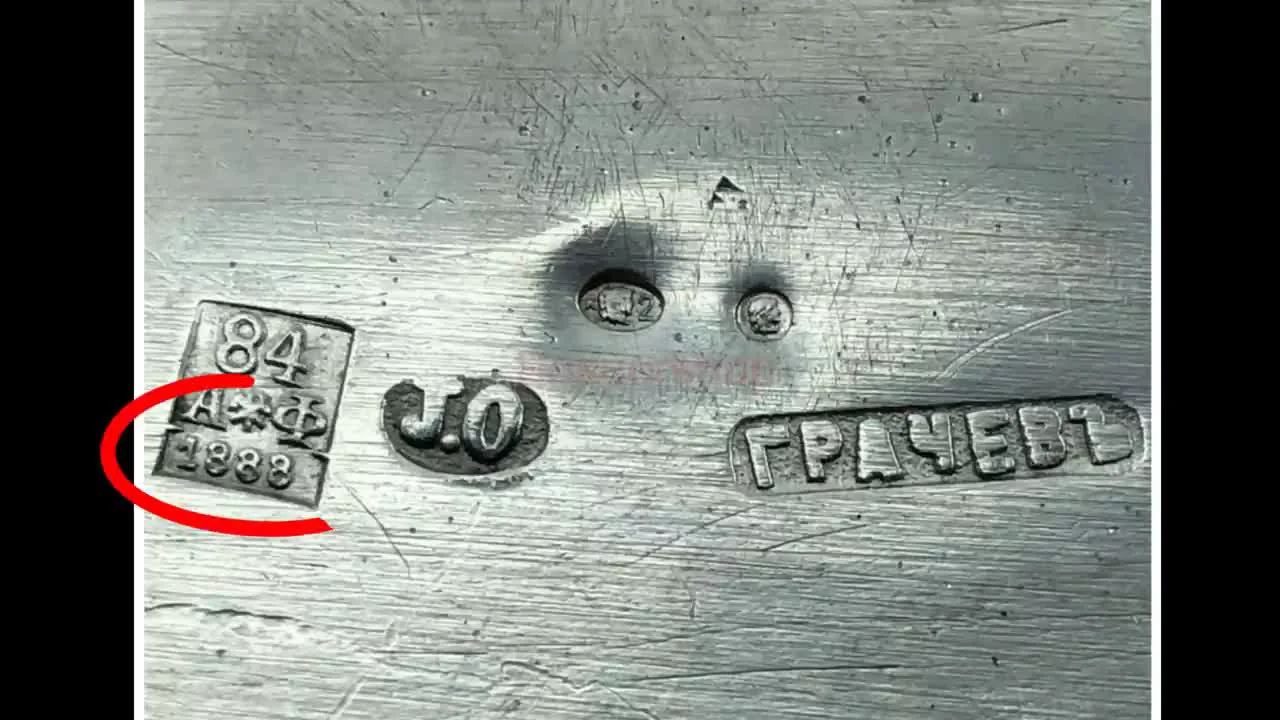
For example, the maker's mark of the famous jeweler Grachev was canceled after his death in 1873. However, ignorant forgers continue to place his mark on items dated to later years, such as 1883. This chronological discrepancy immediately gives away the fake.
The ability to recognize the symbols in assay marks and maker's marks makes it easy to identify 'expired' silver. It's like reading a product label in a store: if you know where to look for the manufacturing date and expiration date, you can easily determine the product's quality.
Obvious Mistakes: Mismatched Dates and Maker's Marks
Hallmarking Technology and the Assay Statute
Term
Description
Maker's Mark (Imennik)
A private mark of the master or manufacturer, which was applied to the item first.
Assay Mark (Proba-udostoverenie)
A state hallmark confirming the purity of the metal and the payment of duty. It was applied after the maker's mark.
Triple Mark (Troinik)
A state hallmark with three segments, including the inspector's initials, the year, the fineness, and the city's coat of arms.
The placement of assay marks, hallmarks, and other symbols on jewelry in the Russian Empire was strictly regulated by the Assay Statute. This document prescribed the procedure for testing the metal and the method for applying hallmarks, which protected items from forgery and certified the payment of duty.
All hallmarks were applied by striking. The maker's mark, assay mark, and other symbols were engraved on a steel rod (punch), which was used to strike the item. First, the jeweler would apply their maker's mark, after which they would take the item to the assay office. There, after a chemical test of the precious metal content and payment of duty, the state assay mark was applied in a similar striking manner.
Hallmarking Technology and the Assay Statute
Technological Signs of an Authentic Hallmark
The main technological sign of authenticity is 'nothing superfluous'. This means that the hallmark impression should be clean and sharp, without any defects. When analyzing authenticity, you should pay attention to the following details:
Within the boundaries of the assay office's impression, there should be no foreign marks or traces on the edges.
The base of the impression should be smooth, without any excess metal, bubbles, or droplets.
The side surfaces of the letters and numbers within the hallmark should be even.
The angle between the plane of the impression's base and the side of the symbols should be exactly 90 degrees.
Technological Signs of an Authentic Hallmark
Methodological Signs: Sequence and Condition of the Item
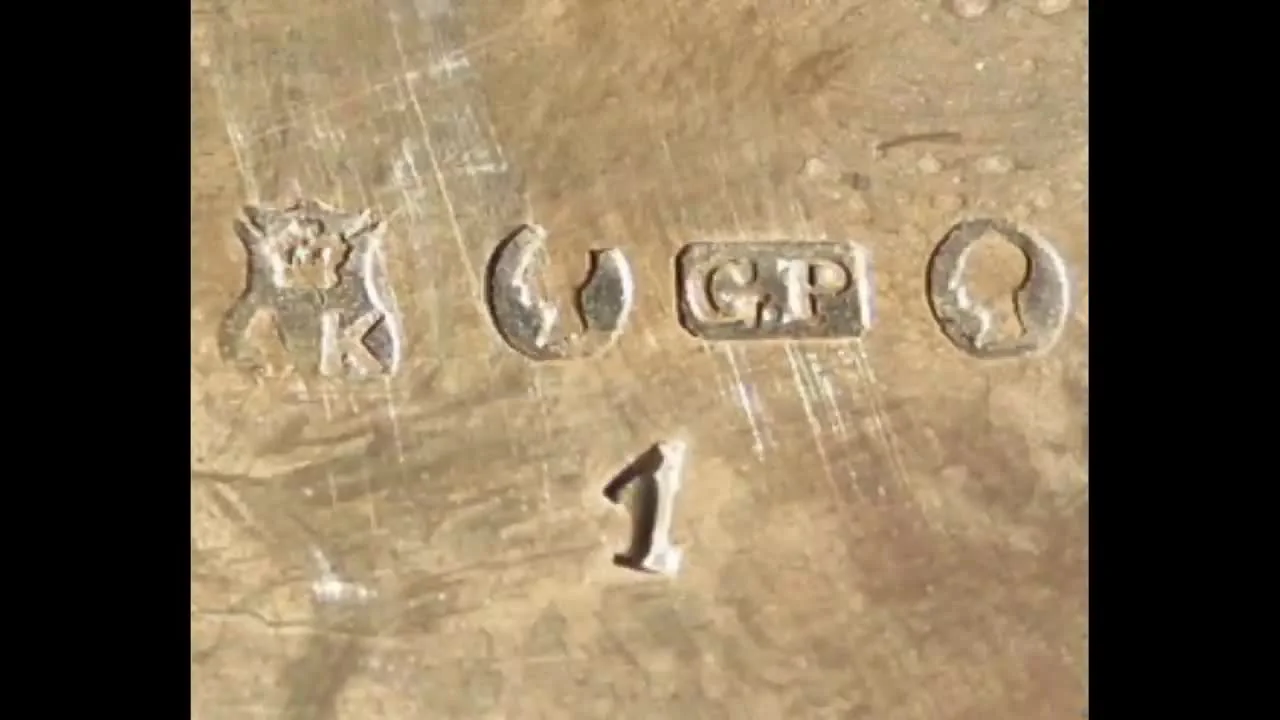
In addition to technological signs, there are also methodological ones established by the Assay Statute. First, a strict sequence was always followed: the master first applied their maker's mark, and only then was the state assay mark applied at the assay office. It was always placed to the right of the maker's mark. Any deviation from this sequence indicates a forgery.
Secondly, masters were required to bring items for hallmarking in a not-fully-finished state. Presenting finished, polished items was forbidden. After the assay mark was applied, the jeweler would finish and polish the item themselves, removing the 'otboy'—the bulge of metal on the reverse side from the punch's strike.
Thus, if an 'otboy' is visible on the reverse side of a hallmark on an item dated before 1898, it should be considered a fake. Also, according to the law, items without a clearly struck maker's mark were not accepted for assaying.
Methodological Signs: Sequence and Condition of the Item
Security Features of Hallmarks from the 1898–1908 Period
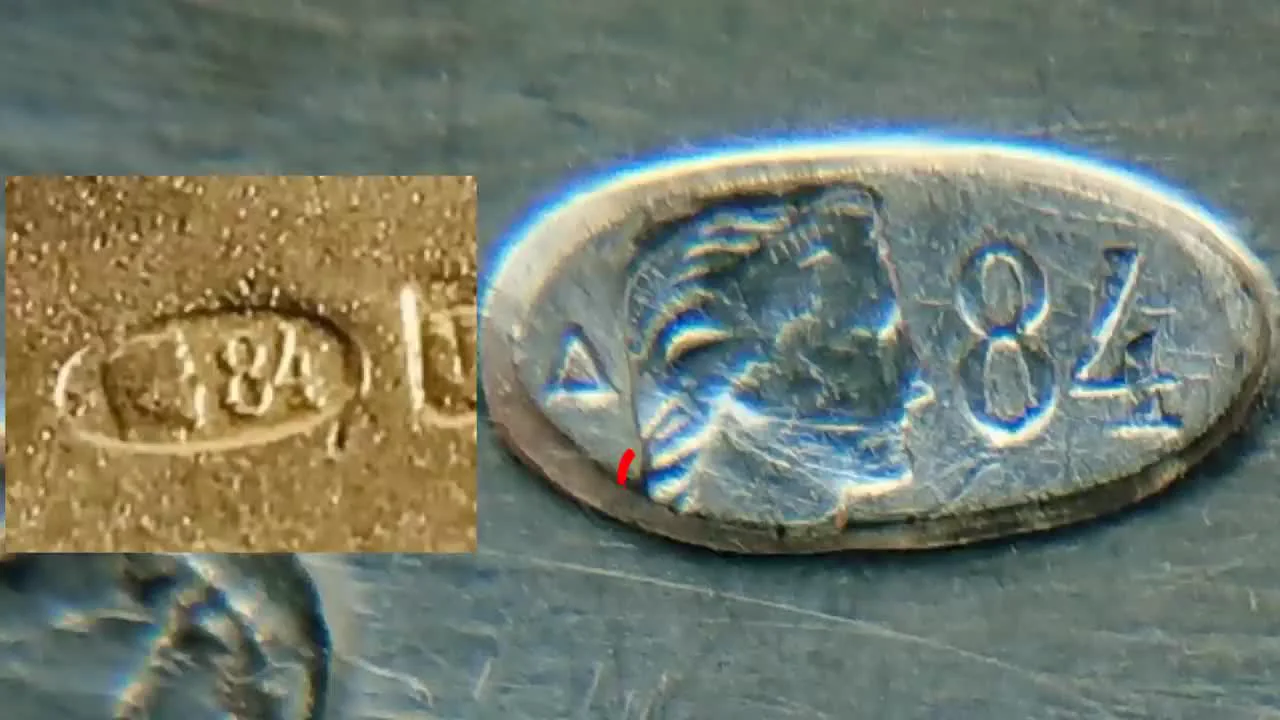
In 1898, a new Assay Statute was introduced, which changed the appearance of the hallmark. It became oval, with a raised image of a woman's head in a kokoshnik, facing right. These hallmarks had a number of security features, the absence of which indicates a forgery.
The woman's eye is always marked by a sharp triangle pointing towards the base of the number '4'.
The ear is shaped like an arc and is a continuation of the chin line.
The chin always protrudes forward, and the lips are marked by a small bump.
Exactly five strands of hair are visible under the kokoshnik.
There is always a small groove between the kokoshnik and the hair.
The nose and the horizontal line of the number '4' are on the same level.
There is always a dot in the center of the ear.
Security Features of Hallmarks from the 1898–1908 Period
Security Features of Hallmarks from the 1908–1917 Period
In 1908, the hallmark design changed again, and new security features appeared. The image of the head in a kokoshnik was now turned to the left. To distinguish an authentic hallmark from this period from a fake one, you should pay attention to the following details:
The woman's braid consists of three strands.
The top strand of hair is always separate.
The woman's nose always has a slight bump, and the lips are clearly distinguishable.
Three strands of hair are visible behind the kokoshnik.
The neck is always cut off by the hallmark's border, making the cut oval.
The assay district code is aligned with the bottom edge of the nose and the dash of the number '4'.
The sides of the number '8' are always thicker than the top and bottom.
Security Features of Hallmarks from the 1908–1917 Period