
A Tax Primer for Gold Investments in Russia
Navigating Tax Obligations for Gold Investments in Russia: VAT, PIT, and Strategies for Optimizing Your Tax Burden.
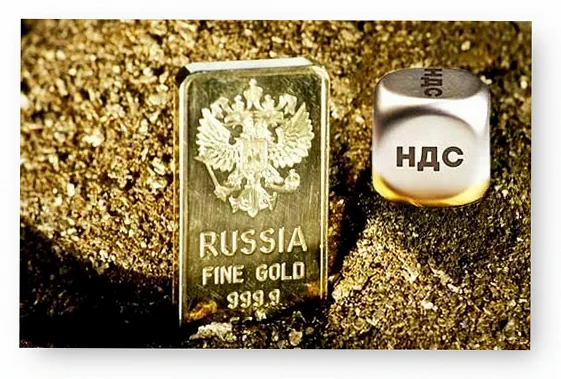
Gold in the Investment Portfolio: What to Remember?
Investing in gold opens up several avenues for investors. One can acquire physical precious metal in the form of coins or bars, open an unallocated metal account at a bank, or invest in exchange-traded funds (ETFs) and mutual funds focused on gold assets.
However, when choosing such methods of preserving and multiplying capital, it is important to study tax obligations in advance. After all, investment profits can be significantly reduced if mandatory payments are not taken into account when buying and selling precious metals within the Russian Federation.
Key Taxes on Precious Metal Transactions
Russian legislation provides for two main taxes accompanying operations with precious metals and related investment instruments.
The first is VAT at 20%, which may arise upon purchase. The second is personal income tax (PIT), which is 13% of the profit obtained from selling gold. Understanding these taxes and possible methods for reducing them is key for every investor.
VAT on Gold Purchases: When and Why?
Value-added tax (VAT) at 20% may be levied when purchasing gold in certain situations. If you acquire gold bars from a bank, their price will already include VAT, which will increase the actual purchase cost.
VAT will also have to be paid when purchasing coins made of precious metals if they are not recognized as official means of payment by the issuing country. When selling precious metal back to a bank, VAT payment is not required.
How to Avoid VAT on Gold Investments?
There are legitimate ways to avoid paying VAT when investing in gold. This can increase the potential return on your investments.
- Purchasing gold bars and storing them in a bank: in this case, VAT is not paid, but you will need to pay for the rental of a bank safe deposit box.
- Opening an unallocated metal account (UMA): this allows you to invest in gold without physically receiving the metal, thus avoiding VAT.
- Buying gold on the exchange: exchange instruments, such as shares of gold mining companies or ETFs, are usually not subject to VAT upon purchase.
- Investing in gold assets through ETFs (exchange-traded funds).
Personal Income Tax on Gold Sales: Features and Burden Reduction
Personal income tax (PIT) at a rate of 13% is levied on profits from the sale of precious metals. This applies to both the sale of gold from a brokerage account and the sale of physical gold coins or bars.
However, there are various opportunities to reduce or even completely exempt from paying this tax on gold investments.
For example, if you have owned a precious metal for more than three years and are not in a hurry to sell it, a tax benefit applies to you, completely exempting you from personal income tax.
If the precious metal has been owned for less than three years, you can use a property deduction for the sale. Gold is considered property, and Clause 2 of Article No. 130 of the Civil Code of the Russian Federation grants the right to corresponding preferential taxation.
Within the framework of the property deduction for reducing tax on gold, two main methods are available:
- Reducing the reported income from the sale by the amount of incurred expenses, which is equal to the purchase price of the gold metal.
- Offsetting tax losses through a possible annual property sale deduction of 250,000 rubles.
NDFL Calculation Examples: Income Optimization
Let's consider specific situations to clearly demonstrate how tax deductions work when selling gold. This will help choose the most favorable taxation scheme.
| Investment Scenario | Sales Revenue | Purchase Costs | Net Income | Property Deduction up to 250,000 RUB | Taxable Base | NDFL (13%) |
| Purchase for 100,000 RUB, sale after one year for 200,000 RUB | 200,000 RUB | 100,000 RUB | 100,000 RUB | Expense deduction used | 0 RUB | 0 RUB |
| Purchase for 300,000 RUB, sale after one year for 400,000 RUB (optimization via expenses) | 400,000 RUB | 300,000 RUB | 100,000 RUB | Expense deduction is more profitable | 100,000 RUB | 13,000 RUB |
| Purchase for 300,000 RUB, sale after one year for 400,000 RUB (optimization via 250,000 RUB deduction) | 400,000 RUB | Not applicable | 400,000 RUB | 250,000 RUB (used) | 150,000 RUB | 19,500 RUB |
As seen from the examples, in case of significant profit, using the scheme of reducing the taxable base by the amount of incurred expenses often proves more profitable than applying the property deduction of 250,000 rubles.
Important Nuances of Gold Taxation
When working with investments in precious metals, it is important to consider a number of features related to document management and investor responsibility.
- When buying or selling precious metal through brokerage firms or banks, the investor is responsible for filling out and submitting the tax declaration.
- If the investor owns precious metal for less than three years, submitting a declaration is mandatory, even if the calculated tax is zero.
- The moment of purchase or sale, as well as all incurred costs, must be documented.
- In recent years, the government has been considering the possibility of abolishing VAT for individuals when purchasing gold bullion, but the corresponding legislative changes have not yet been adopted.
Taxes on Investments in Gold ETFs
Investments in securities of gold exchange-traded funds (ETFs) have their own tax specifics. Since these securities do not fall into the category of property assets, NDFL at 13% is applied only to the income received from their sale.
There are opportunities to reduce the tax burden when investing in ETFs:
- If ETF securities are owned by the investor for less than three years, the taxable amount can be reduced by 3,000,000 rubles for each year of ownership.
- Purchasing ETF assets on a Type 2 Individual Investment Account (IIA), which completely exempts sales income from taxation.
- Using other legal methods of tax optimization.
An important advantage of working with ETFs is that the broker typically acts as a tax agent. This means that the investor is not required to independently complete a tax declaration and pay tax on investments.
Summary: Maximizing Profit from Gold Investments
Understanding tax regulation is a key aspect of successful gold investments. In most cases, purchasing and selling precious metals or investment instruments based on them requires filing a tax declaration.
To optimize the tax burden, it is worth remembering a few important points. When selling gold with a profit of up to 250,000 rubles annually, you can avoid paying personal income tax by utilizing a property deduction. Owning the metal for more than three years completely exempts it from tax.
The most favorable tax conditions often apply to investments in ETFs or unallocated metal accounts. Investments in bars may be less profitable due to VAT and are also associated with liquidity issues. At the same time, investment coins, which are not subject to VAT, offer good liquidity and several other advantages for the investor.