
The Coin: Its Heft, Its Heritage, Your Capital. Invest with Discernment.
Why a coin's true value transcends its gold content. We delve into how ancient currency transformed into a powerful asset, serving as a potent hedge against inflation.
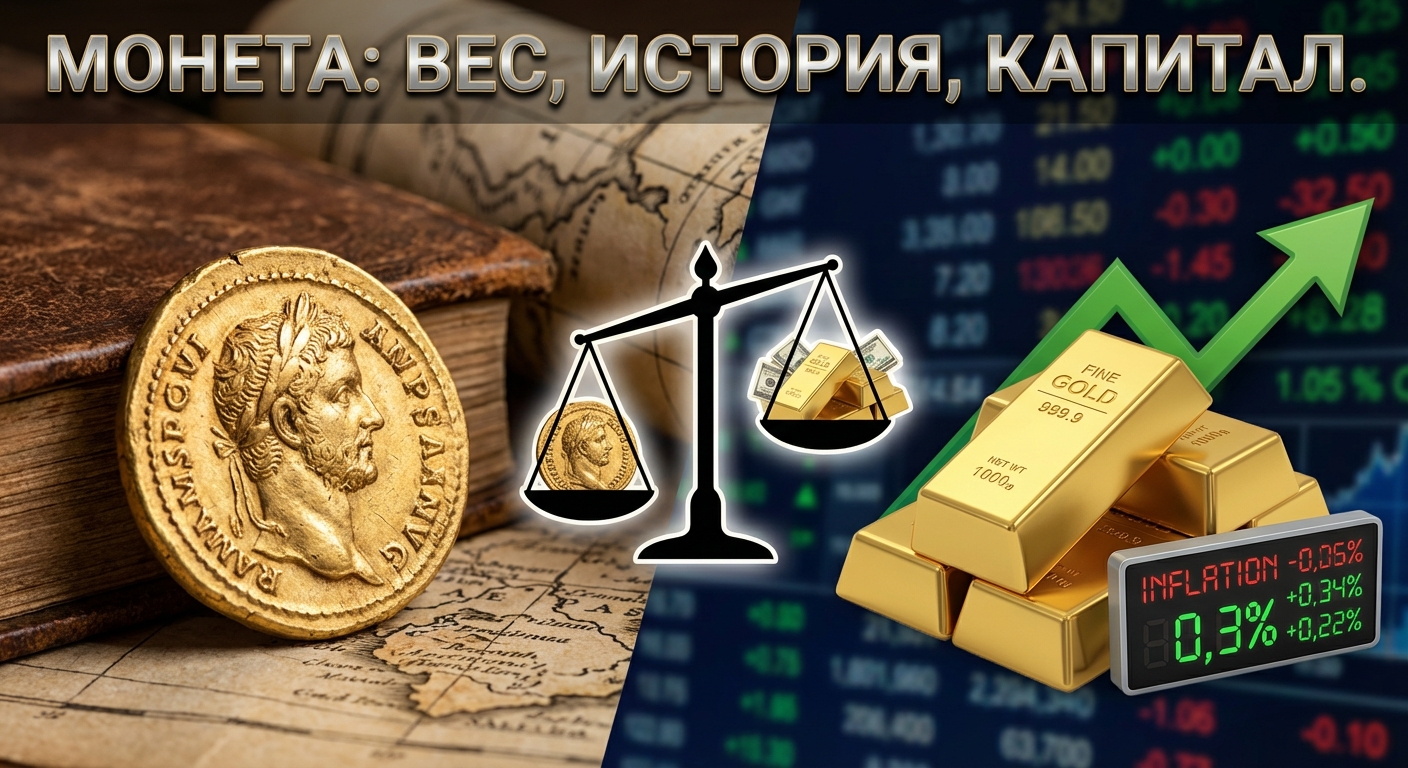
More Than Just Metal: Why History Makes a Coin Golden
Think gold is just a shiny metal? Think again. The real magic begins when history enters the scene. When behind every gram stands not just a stock market quote, but millennia of events, culture, and power. For the modern investor, it's not just "the weight of metal," it's "the weight of history." And here's why that matters.
Where Did the Coin Come From? A Tale of Juno and Peter the Great
Do you know where the word "coin" comes from? It's not just random! The Romans named it after the goddess Juno Moneta – she who warns. Even then, money became a symbol not only of exchange but also... security. The first coins were minted near her temple, and the name stuck. Symbolic, isn't it?
Peter the Great, an enlightened man, understood the trick. He borrowed the word not just to denote "money," but to signify a new, unified currency according to European standards. Not just a piece of metal, but CURRENCY, a symbol of stability and state power. This was the first step towards the coin becoming something more than just a mere ingot.
Before Coins: Salt, Shells, Chaos
Before? Barter. Salt, grain, furs, cowrie shells. Total chaos! Want bread – drag a bag of salt. Weigh it, evaluate it every time. This hindered trade, killed the economy.
Then it dawned: a universal, lasting, compact resource was needed. With high value in a small volume. Hello, precious metals! They became the salvation. But how to standardize them?
The Metal Revolution: First Golden Injections
Around 600 BC, Lydia. King Alyattes II minted staters from electrum (a natural alloy of gold and silver). And his successor, the legendary Croesus, issued the first ever GOLD coins!
- Stamping: no longer just weighed, but guaranteed in weight and composition.
This was a revolution! Coins were easy to carry, they were recognized everywhere. A stimulus for markets, trade, and the state. A coin became not just a medium of exchange, but also an instrument of power.
Turtles, Spades, and Ducats: The Global Evolution of Money
Lydia started the wave. Aegina – a maritime power – picked it up, minting its famous silver 'sea turtles.' This wasn't just exchange; it was a brand, status, and symbol of the island.
India? Punch-marked coins with animal and sun symbols. China? Wild 'spade coins' and 'knife coins,' then – a round coin with a square hole that lasted two thousand years! Do you understand the power of the IDEA?
Middle Ages: The Roman Empire collapsed, but coins did not! Charlemagne's Denarius – a single currency throughout Europe. Then the golden florin, the Venetian ducat. A coin became not just money, but a FLAG. A symbol of power, economy. And, of course, a store of value.
Modern Era: The world surged forward! Trade, discoveries. Thalers (the future dollar), rubles, guineas. Complex designs, cool technologies – to prevent counterfeiting and clipping. Value was no longer just in the metal, but also in PROTECTION. In the state's GUARANTEE.
20th Century: Metal vs. History. What Will You Choose?
19th–20th centuries: wars, crises. Gold phased out of circulation. But investment coins emerged. For example, the legendary South African Krugerrand. Simple design, huge mintage. Pure metal. And it's great for preserving capital against inflation.
BUT! There's something else…
Numismatic Verdict: When 1+1 = 10
This is where the main point begins. An investment coin is, in essence, a bullion in the form of a coin. Its price is the weight of the metal + a small premium for minting.
And a rare, historical coin? That's a completely different league. It's THE WEIGHT OF THE METAL + HISTORY + RARITY + COLLECTOR DEMAND. This formula creates a synergy effect.
Don't confuse mere gold with GOLD with a history. The former is a basic hedge against inflation. The latter is an investment with EXPLOSIVE potential, possessing unique liquidity in the collector's market. A coin's history is your additional capital.
Call to Action:
Want to not just preserve, but multiply? Look deeper than just grams. Look at the history. ART BURG will help you find the very coins that will become not only a part of your capital but also your own collection of priceless stories.