When to Buy Gold: An Analysis of Investing in Times of Crisis - AUCBURG | AUCBURG
When to Buy Gold: An Analysis of Investing in Times of Crisis
Amid another crisis, the price of gold continues to rise, attracting increasing attention. People are actively buying the precious metal, despite its high cost, in an effort to secure their savings during unstable times.
Amid another crisis, the price of gold continues to rise, attracting increasing attention. People are actively buying the precious metal, despite its high cost, in an effort to secure their savings during unstable times.
This frenzy reflects the desire to protect capital from depreciation, as gold is historically considered a reliable asset during economic turmoil.
The History of Gold Investing: From 2009 to Today
Period
Price per 1 gram of gold
2009
20-22 euros
Present day
115-117 euros
Interest in gold as an investment tool is not new. Discussions on this topic were held as far back as 8-9 years ago, covering various aspects: from investing in jewelry and comparisons with silver to the specifics of buying gold in different countries, such as Dubai, Belarus, Italy, and Turkey.
Interest in this asset emerged even earlier, around 2009. At that time, the price of gold was significantly lower, which demonstrates its long-term growth potential.
Over the past years, serious topics such as a potential ban on private gold ownership ('Goldverbot') and building pension savings with gold coins have also been discussed.
The History of Gold Investing: From 2009 to Today
Inflation as a Form of Expropriation
Former German Chancellor Angela Merkel, back in November 2007, described inflation as 'the most insidious form of expropriation for small savers who do not own tangible assets.' This statement accurately describes the current economic processes that cannot be ignored when considering investments in gold.
Inflation 'eats away' at money, reducing its purchasing power.
The remaining money supply is planned to be digitized, meaning converted into an electronic, fully controlled form, which implies the gradual phasing out of cash.
A reaction to these processes could be the revival of barter, where tangible assets are exchanged directly for goods and services.
Inflation as a Form of Expropriation
Tighter Controls on Gold Purchases
Period
Anonymous purchase limit
Before 2017
up to 15,000 euros
Since July 2017
up to 10,000 euros
Since January 1, 2020
up to 2,000 euros
Lawmakers have already anticipated possible reactions to economic instability and have taken steps to strengthen control. One such step has been the progressive reduction of the limit on anonymous gold purchases.
Whereas it was once possible to purchase gold for a significant amount without personal identification, these rules have now become much stricter.
Thus, today one can anonymously buy gold only for an amount up to 1,999 euros. Any purchase exceeding this limit requires the presentation of identification documents.
Prospects: Total Asset Registration and a Possible Gold Ban
The European Union plans to create a single European register for citizens' tangible assets. It is proposed that all property valued at over 200,000 euros, whether it be real estate, stocks, bitcoins, antiques, or gold, will have to be declared. In the future, this threshold may be lowered.
In response to the economic consequences of crises, a so-called 'Lastenausgleich' (burden sharing), as was done after the war, may be introduced. This mechanism implies that asset owners are obligated to participate financially in the economic recovery.
The next step could be a 'Goldverbot' — a ban on private gold ownership. Historical examples of such measures exist in various countries, including the Weimar Republic, the Third Reich, the USA, and Russia. In such a case, citizens could be required to surrender their gold to the state at a fixed, rather than market, price.
Prospects: Total Asset Registration and a Possible Gold Ban
Experiment: How a Loan for Gold Yielded an 80% Profit
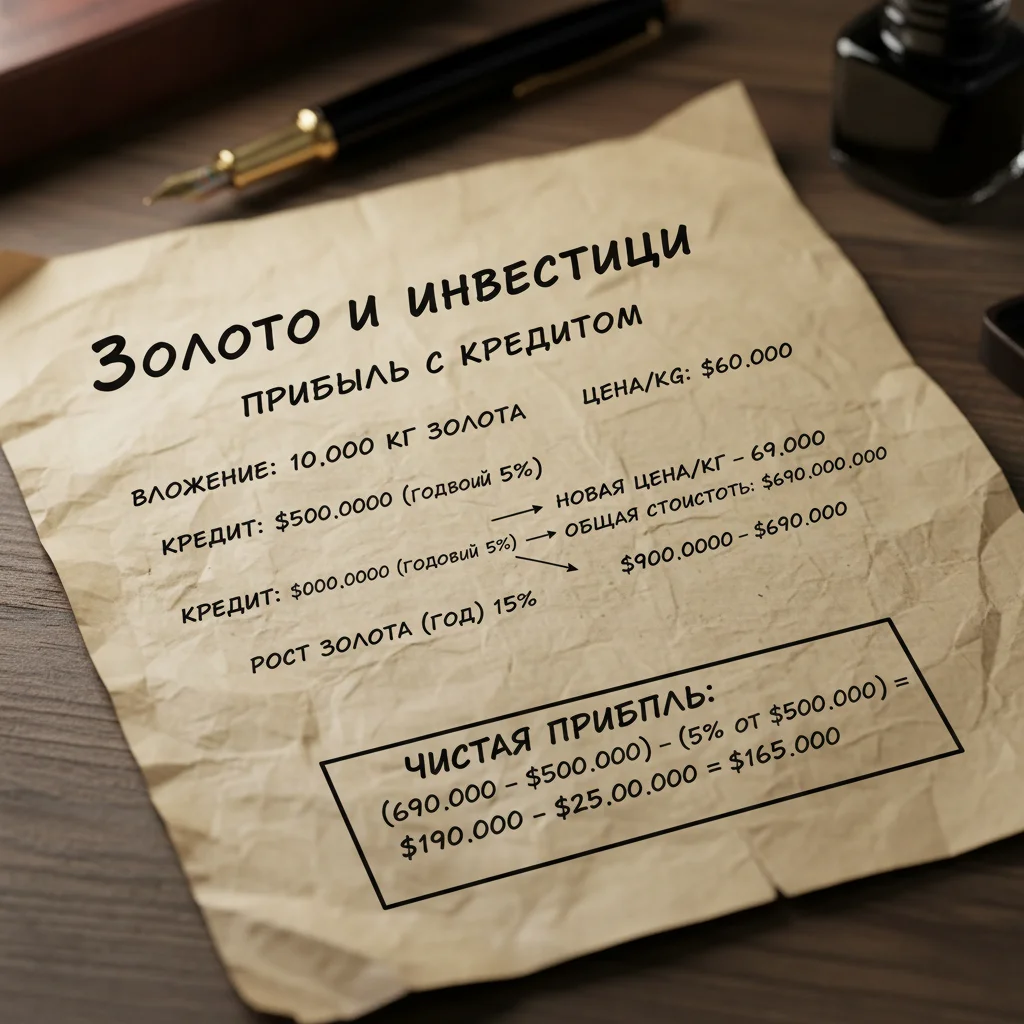
Four years ago, an interesting experiment was conducted. A loan of 10,000 euros was taken from a bank at 2.8% per annum. The entire amount was used to buy gold coins — Austrian ducats from 1915.
Four years later, the loan was fully repaid. During this time, the increase in the price of gold not only covered all loan expenses but also brought a significant profit.
Loan amount: 10,000 euros
Total amount to be repaid (with interest): 11,500 euros
Current value of the purchased gold: around 20,000 euros
Net profit: approximately 8,500 euros
This example shows that even with borrowed funds, investing in gold can be very profitable, yielding about 80% profit over four years without the significant risks typical of stocks or cryptocurrencies.
Experiment: How a Loan for Gold Yielded an 80% Profit
Practical Matters: Buying, Storing, and Selling
Investing in gold involves three main stages: buying, storing, and selling. Each has its own nuances, which have been discussed previously. This concerns the choice of gold form (bars, investment or historical coins, jewelry), as well as methods of storage: in bank safe deposit boxes, at home, or abroad.
As for jewelry, buying it in stores is unprofitable due to the high markup for craftsmanship. However, acquiring 'jewelry' at scrap price can be profitable, as it can be sold for more than the value of the metal it contains.
Unlike real estate, gold is a mobile asset. A one-kilogram bar is about the size of a modern mobile phone, which facilitates its transportation. Moreover, gold has high liquidity — it is much easier to sell than, for example, diamonds.
Practical Matters: Buying, Storing, and Selling
Should You Buy Gold Now?
Many investors are wary of buying gold at its peak price. However, who can say with certainty that the current price is the limit? Perhaps this is only halfway there. The price growth is driven by fundamental reasons: political and economic instability, as well as the decline of leading economies.
It is indicative that many countries, including Russia, China, and India, are actively replenishing their gold reserves. This suggests that major players are betting on gold as a strategic asset.
For a private investor with available funds, buying gold remains relevant. Considering its mobility, liquidity, and status as a safe-haven asset, investing in gold can be considered at any time, especially in the current unstable situation.