
Golden Panda: The Legendary Coin Shaping the World of Investments and Collecting
Immerse yourself in the history of one of the world's most recognizable investment coins — the 'Chinese Panda'. Discover its unique design, the evolution of its denominations, and the enigmas surrounding its minting.
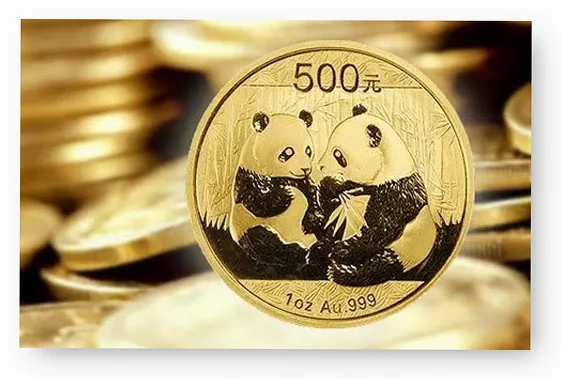
From Debut to Cult Status: The Birth of the Golden 'Chinese Panda'
The 999 fine gold coins of the 'Chinese Panda' series were first minted in 1982, instantly gaining recognition from investors and collectors. This series quickly became one of the most popular in the world of numismatics.
China ordered 16,000 one-ounce 'Pandas' in the debut year of 1982, and the entire mintage sold out within months. Soon after, the value of these gold coins quadrupled on the secondary market from their original price.
Already in 1985, the American Numismatic Association recognized the exceptional nature of the series, awarding the 1983 one-ounce 'Panda' the title of 'Coin of the Year'. This underscored its significance in the global investment coin market.
A Design That Breathes: The Unique Evolution of the Reverse
The Golden 'Chinese Panda' became the first investment coin in history whose reverse design changes annually. This feature gives it a special appeal among collectible coins.
When the Chinese government decided to keep the design unchanged in 2001, it caused widespread indignation among enthusiasts. As a result, despite the fact that the coins of those years had the same design, it was decided to resume the tradition of annual design changes, starting with the 2003 issue.
The reverse of these gold coins, first designed by Shanghai artist Chen Jian, always features an image of a panda. This endearing animal has become the series' symbol and its recognizable characteristic.
Over time, the design evolved: from 2001 onwards, a mother panda and her cub became the main subjects, and the 2013 issue was dedicated to three adult pandas. While the reverse changes every year, the obverse consistently depicts the Temple of Heaven in Beijing.
This majestic temple, an entire architectural complex, was built in the 15th century by Emperor Yongle. It served as a venue for annual harvest ceremonies and is an important cultural symbol of China.
From Ounces to Grams: Evolution of Denominations and Markings
Initially, the weight and purity of the metal on Chinese Panda gold coins were indicated in both Chinese and English, but the face value was absent. It was added only the year after the first issue.
Ten years later, the weight and purity began to be indicated only in English. Another notable design change occurred in 1992: since then, the Temple of Heaven on the obverse has been surrounded by a large ring.
In the first year of the series' existence, the Shanghai Mint struck gold coins in one, half, quarter, and one-tenth ounce denominations. For almost 20 years, these weights were denominated as one hundred, fifty, twenty-five, and ten yuan, respectively.
A year after the first issue, a one-twentieth ounce Panda with a face value of five yuan was introduced. In 2001, all denominations were revised, and the face value of one-ounce gold coins increased from 100 to 500 yuan.
One of the most significant changes was made seven years ago when ounces as units of weight were replaced by metric grams. Now, the 500 yuan one-ounce coin weighs 30 grams (which is 0.9645 ounces), and the 200 yuan half-ounce coin weighs 15 grams (0.4823 ounces).
| Period | Characteristics |
| First Issues (from 1982) | Weights: 1, 1/2, 1/4, 1/10 oz |
| From 1983 | 1/20 oz added (5 yuan denomination) |
| Almost 20 years | Denominations: 100 (1 oz), 50 (1/2 oz), 25 (1/4 oz), 10 (1/10 oz) yuan |
| From 2001 | All denominations revised; 1-oz coin up to 500 yuan |
| 7 years ago | Transition to grams: 30g (0.9645 oz) for 500 yuan; 15g (0.4823 oz) for 200 yuan |
Rarity and Scale: Special Issues and Mintage
In addition to standard investment coins, China also minted several exceptionally large specimens. In 1984, a 12-ounce Chinese Panda was released, followed by a 5-ounce one in 1987, a 5-kilogram one in 1991, and a 1-kilogram one in 1997.
All these unique gold coins were available only in Proof finish, which emphasized their collectible value and exclusivity. They are of particular interest to numismatists.
For 18 years, starting in 1982, the 'Chinese Panda' gold coins were produced according to demand. This meant that the mintage was unlimited, and production continued as long as the People's Bank of China received orders.
All subsequent issues had a strictly limited maximum mintage. However, the China Mint traditionally reveals its plans with great caution, and sometimes the true mintage volume remains in question.
The government regularly reports only on the total number of ounces minted per year. In the period from 19 year, the Mint issued a total of 2,174,174 ounces of gold, and from 19 year, 4,926,360 ounces.
Overall, approximately 24 million coins of all denominations have been minted, which indicates a significant production volume of these popular investment coins.
Mysteries of the Mints: Secrets of the 'Panda's' Origin
Despite their widespread popularity, even minor details of the 'Chinese Panda' gold coin series are shrouded in mystery. For instance, most 'Pandas' lack a mint mark.
Only in 1987 were special letters minted on the coins: 'S', denoting the Shanghai Mint, and 'Y', indicating belonging to the Shenyang Mint.
However, it is known that these gold coins were issued by three different mints: Shanghai, Shenyang, and Shenzhen. Their periods of work on the series were distributed as follows:
- **Shanghai Mint:** minted gold 'Pandas' from 19 year.
- **Shenyang Mint:** was involved in production from 19 year and from 20 year.
- **Shenzhen Mint:** worked on the series from 19 year and from 2005 to the present.
Despite the absence of explicit mint marks, subtle design differences can help identify the minting location of specific specimens. One such distinction is the size of the date.
Large-date 'Chinese Panda' coins were traditionally minted in Shanghai, while small-date specimens were produced at the Shenyang Mint. This is an important nuance for collectors.
It is interesting to note that many Proof coins feature a small letter 'P'. This distinctive mark helps differentiate them from bullion (BU) coins, and the letter 'P' is most often located near the right paw of the panda depicted on the reverse.
Investment Appeal: From VAT Exemption to Buyback Program
Ten years ago, in December 2012, China's Ministry of Finance and the State Administration of Taxation made a landmark decision. They exempted buyers of 'Chinese Panda' gold coins from paying a 17% value-added tax (VAT).
This decision significantly increased the investment appeal of gold coins. It allowed the national association, China Gold Coin Incorporation, to introduce a buyback program for gold 'Panda' coins from the public through retail outlets in Beijing, Shanghai, and Shenzhen in September 2013.
Thanks to this, the association gained the opportunity not only to buy back coins but also to resell them for profit, contributing to the development of the domestic precious metals market.
Diversity of Metals: Expanding the 'Chinese Panda' Series
Building on the tremendous success of the gold series, the Chinese government introduced silver specimens in 1983. As with the gold coins, the reverse design on silver coins also changes annually.
In 1987, a series of platinum 'Pandas' appeared, which also attracted collectors' attention. However, due to the significant rise in platinum prices, the production of this series was discontinued after 18 years.
Interestingly, the 'Chinese Panda' series also includes a number of bimetallic coins, which were minted from 19XX. These unique coins consist of a silver outer part and a gold center, representing a rare example of combining precious metals in a single coin.